
ATS Software UK 2026 | Talent Acquisition Management

ATS Systems UK 2026 – Best ATS Software & Applicant Tracking Systems for Smarter Hiring
- Last Updated: January,12,2026
- Pricing Verified: January,12,2026
- Features Checked: January,2026
About The Author
Reviewed by: Shivam Gupta, HR Specialist at Pitch N Hire
- Experience: 10+ years in HR and recruitment management
- Previous Role: HR Specialist, Gigde Global
- Current Position: HR Specialist, Pitch N Hire
- Expertise Focus: ATS platform evaluation, UK recruitment compliance, HR technology implementation
- Contact: shivam.gupta@gigde.com | LinkedIn: Pitch N Hire
About Pitch N Hire
- Founded: 2017
- What We Do: Pitch N Hire is a revolutionary applicant tracking software UK platform designed to streamline and simplify the hiring process for UK organizations. Our platform equips companies with all the essential tools needed to advertise jobs across multiple channels effectively, make data-driven hiring decisions, seamlessly sort and manage applications, design branded mobile-responsive career pages, track recruitment funnels from a single unified dashboard, and attract top talent to build exceptional teams.
- Team Size: 51-200 employees across the UK
- Website: https://pitchnhire.com/
- Key Contact: info@pitchnhire.com | https://pitchnhire.com/contact-us
The UK recruitment landscape has transformed dramatically. With hybrid work models becoming permanent, candidate volumes surging, and regulatory requirements tightening, British businesses need more than spreadsheets and email chains to manage hiring effectively.
ATS systems UK (Applicant Tracking Systems) have evolved from simple database tools into sophisticated AI-powered ATS UK platforms that automate screening, ensure compliance, and dramatically reduce time-to-hire. Whether you're a startup hiring your first employee or a mid-sized company scaling rapidly, choosing the right ATS software UK in 2026 isn't just about efficiency—it's about survival in an increasingly competitive talent market.
This comprehensive guide explores everything UK employers need to know about applicant tracking system UK solutions, from GDPR compliance to AI capabilities, helping you make an informed decision that transforms your recruitment process.
The Evolution of ATS Systems UK

Why UK Hiring Has Changed Dramatically Since 2020
The British recruitment sector has undergone seismic shifts since 2020. Four major forces have reshaped how UK companies attract, assess, and hire talent:
Remote and Hybrid Work Revolution: The pandemic permanently altered workplace expectations. UK recruiters now compete for talent nationwide—and often globally. Traditional location-based hiring strategies have become obsolete. Modern recruitment technology UK must support distributed teams, virtual interviews, and remote onboarding seamlessly.
Exponential Candidate Volume Growth: With remote work eliminating geographical barriers, a single job posting can generate hundreds of applications. A 2025 CIPD study found that UK employers receive 47% more applications per role than in 2019. Without robust UK recruitment platform tools, quality candidates get lost in the noise while recruiters drown in CVs.
Intensified Compliance Pressure: GDPR, the Equality Act 2010, and Right to Work verification requirements have made manual hiring processes legally risky. A single data handling mistake can result in substantial ICO fines. GDPR compliant ATS UK solutions aren't luxuries—they're regulatory necessities.
Elevated Candidate Experience Standards: Today's job seekers expect Amazon-level user experiences. Mobile-friendly applications, instant acknowledgments, transparent timelines, and responsive communication are baseline expectations. Companies with clunky hiring processes lose top talent before the first interview.
These converging pressures explain why hiring software UK adoption has accelerated dramatically. The question is no longer whether to implement an ATS, but which system best fits your organization's specific needs.
From Manual Hiring to AI-Powered ATS UK
The evolution of recruitment system UK technology mirrors broader workplace digitalization trends:
The Spreadsheet Era (Pre-2015): Recruiters managed candidates through Excel files, shared drives, and email folders. This manual approach created version control nightmares, made collaboration difficult, and offered zero insight into hiring metrics. Candidate data lived in silos, making it nearly impossible to build talent pools or track recruiting effectiveness.
First-Generation ATS Platforms (2015-2020): Early ATS platforms UK centralized candidate data and automated basic tasks like resume parsing and email responses. However, these systems were often rigid, difficult to customize, and required extensive training. They solved database problems but created new usability challenges.
AI-Powered Modern ATS UK (2020-Present): Today's AI recruitment software UK represents a quantum leap forward. Machine learning algorithms screen resumes with human-level accuracy, natural language processing extracts skills from unstructured text, and predictive analytics identify candidates most likely to succeed. These systems don't just store information—they actively improve hiring decisions.
The 2026 Standard: Current AI-powered ATS UK solutions combine automation, intelligence, and user experience in ways unimaginable five years ago. Features like conversational AI chatbots that pre-screen candidates, automated interview scheduling across time zones, and bias-detection algorithms that flag potentially discriminatory language have become standard rather than innovative.
For UK businesses still relying on manual processes, the competitive disadvantage grows daily. Companies using modern recruitment automation software UK fill positions 42% faster and see 37% better quality-of-hire metrics, according to 2025 CIPD research.
What Is an Applicant Tracking System UK & How It Works

What Is an ATS System UK? (Beginner-Friendly Explanation)
An applicant tracking system UK is specialized software that manages every stage of the recruitment lifecycle—from creating job descriptions to making final hiring decisions. Think of it as a comprehensive command center for talent acquisition.
Core Purpose: ATS systems solve three fundamental recruitment challenges simultaneously:
- Organization: Centralizes all candidate information, communications, and hiring workflows in one accessible platform
- Efficiency: Automates repetitive tasks like resume screening, email communications, and interview scheduling
- Compliance: Ensures hiring processes meet UK legal requirements including GDPR, Equality Act provisions, and Right to Work verification
Who Should Use It: While historically adopted by large enterprises, modern cloud-based ATS UK solutions are now essential for organizations of all sizes:
- Startups (1-50 employees): Establishes professional hiring processes from day one, preventing the chaos that comes with rapid growth
- SMBs (51-500 employees): Scales recruitment operations without proportionally increasing HR headcount
- Enterprises (500+ employees): Manages complex, multi-location hiring with standardized workflows and advanced analytics
The democratization of recruitment technology UK means even bootstrapped startups can access sophisticated hiring tools previously reserved for Fortune 500 companies.
Step-by-Step Workflow of ATS Software UK
Understanding how recruitment system UK platforms function helps clarify their value proposition:
Step 1: Job Creation & Approval Workflow Hiring managers create job requisitions within the ATS using customizable templates. The system routes approvals through appropriate stakeholders (department heads, HR, finance) based on configurable business rules. This creates audit trails and ensures budget compliance before positions go live.
Step 2: Multi-Channel UK Job Board Distribution Modern UK hiring software integrates with major British job boards (Indeed UK, Reed, Totaljobs, CV-Library) plus niche sector-specific platforms. A single click publishes positions across multiple channels simultaneously while tracking which sources generate the highest-quality applicants. Integration with LinkedIn, company career pages, and employee referral portals ensures comprehensive reach.
Step 3: Automated Resume Collection & Parsing As applications arrive from various sources, the ATS software UK automatically parses CVs to extract structured data: contact information, work history, education, skills, and certifications. Advanced systems use AI to understand context, recognizing that "project management" appears in a candidate's experience even if they never explicitly listed it as a skill.
Step 4: AI-Powered Candidate Screening This is where AI applicant tracking system UK technology truly shines. Machine learning algorithms score candidates against job requirements, ranking applicants by predicted fit. The system can automatically reject clearly unqualified candidates with personalized emails, while flagging top prospects for immediate recruiter review. This screening happens in minutes rather than days.
Step 5: Collaborative Interview Scheduling Once candidates advance, the ATS manages interview coordination—traditionally one of recruitment's most time-consuming tasks. Modern platforms offer candidates self-service scheduling links that sync with interviewer calendars, automatically handling time zone conversions and sending reminders to all parties.
Step 6: Hiring Decision & Compliance Documentation After interviews, hiring teams collaborate within the ATS to make decisions, with all feedback and scoring documented. Once an offer is extended, the system stores all recruitment documentation to demonstrate compliance with UK employment law, creating defensible records in case of discrimination claims or ICO audits.
Throughout this workflow, the recruitment automation software UK maintains complete GDPR compliance, managing candidate consent, data retention policies, and deletion requests automatically.
Best ATS Systems UK 2026 – Platform Comparison Framework

How Pitch N Hire Evaluate Top ATS Systems UK
Selecting the right ATS software UK requires systematic evaluation across multiple dimensions. Our methodology for assessing top ATS systems UK considers these critical factors:
Feature Completeness & Innovation: Does the platform offer comprehensive functionality spanning the entire recruitment lifecycle? We evaluate AI capabilities, integration ecosystems, reporting depth, collaboration tools, and innovative features that differentiate leading platforms from basic systems.
Transparent & Competitive Pricing: The best ATS UK providers offer clear pricing without hidden fees for essential features. We assess cost structures (per-user, per-job, or flat-rate), minimum commitments, implementation fees, and overall value relative to capabilities delivered.
Regulatory Compliance Rigor: Given UK legal requirements, we scrutinize GDPR features, Equality Act support, Right to Work tools, and data security certifications. Platforms lacking comprehensive UK recruitment compliance software capabilities receive significant deductions regardless of other strengths.
Customer Support Quality: Recruitment is time-sensitive. We evaluate support responsiveness, availability (24/7 vs business hours), channel options (phone, chat, email), and the quality of training resources provided. Top applicant tracking systems UK offer dedicated UK-based support teams familiar with British recruitment practices.
Implementation & Usability: The best system is worthless if your team won't use it. We assess implementation timelines, training requirements, interface intuitiveness, and mobile experience. Platforms requiring months of configuration or extensive training create adoption barriers.
Scalability & Flexibility: Your hiring needs will evolve. We evaluate how well platforms accommodate growth—from 5 annual hires to 500—and whether customization options allow adaptation to unique recruitment workflows without expensive professional services.
Integration Ecosystem: No ATS exists in isolation. We assess integrations with job boards, background check providers, assessment platforms, HRIS systems, and other recruitment technology. Comprehensive ATS platforms UK offer robust API access and pre-built integrations.
Demonstrated Results: Finally, we consider user reviews, case studies, and measurable outcomes. Do customers report improved time-to-hire? Better candidate quality? Reduced cost-per-hire? Evidence of real-world impact separates marketing claims from genuine value.
Customer Reveiws
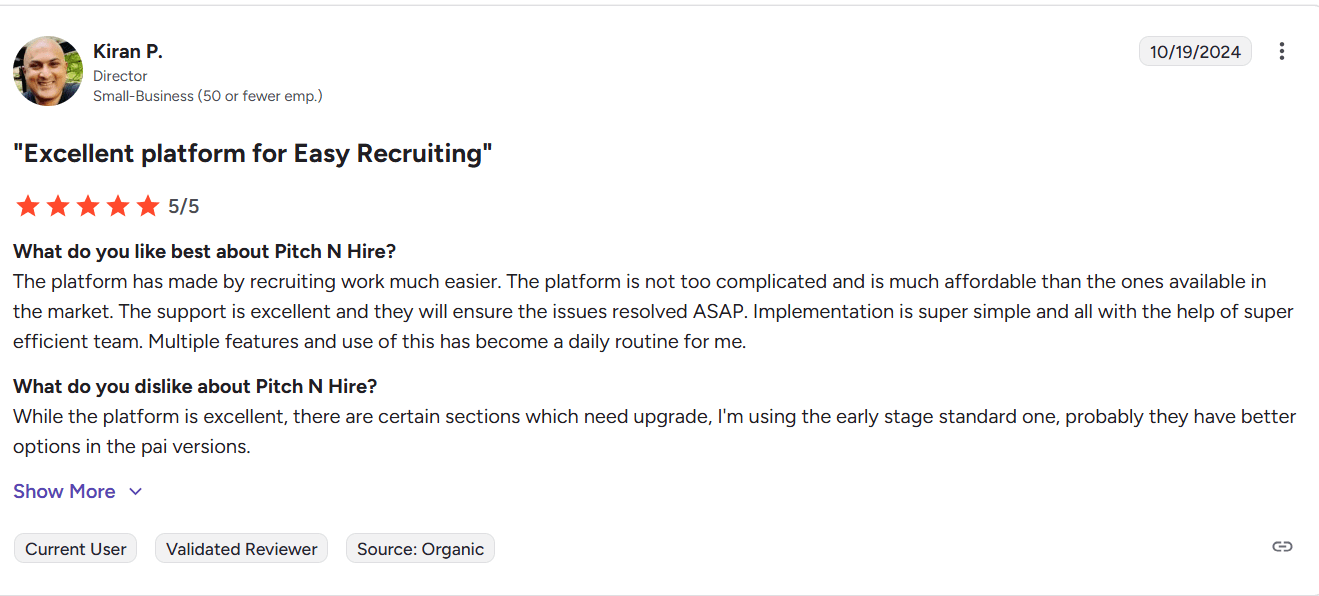
Customer Name: Kiran P.
Role: Director (Small Business)
“Pitch N Hire has made our recruitment process extremely smooth. The platform is easy to use, helps us track candidates efficiently, and the customer support team is very responsive. It’s a great ATS for small and growing businesses.”
Read verified Pitch N Hire customer reviews on G2
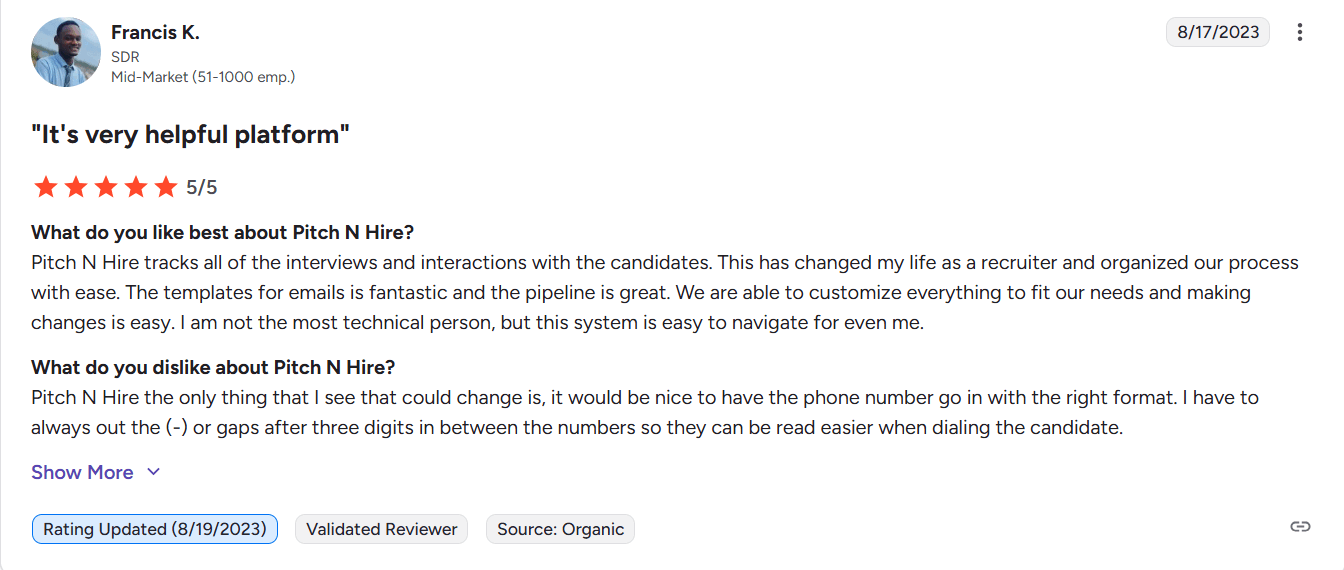
Customer Name: Francis K.
Role: Sales Development Representative (Mid-Market)
“What I really like about Pitch N Hire is how clearly it tracks interviews and candidate communication. Even non-technical team members can use it without any training. The interface is clean and intuitive.”
Explore real Pitch N Hire ATS reviews on G2
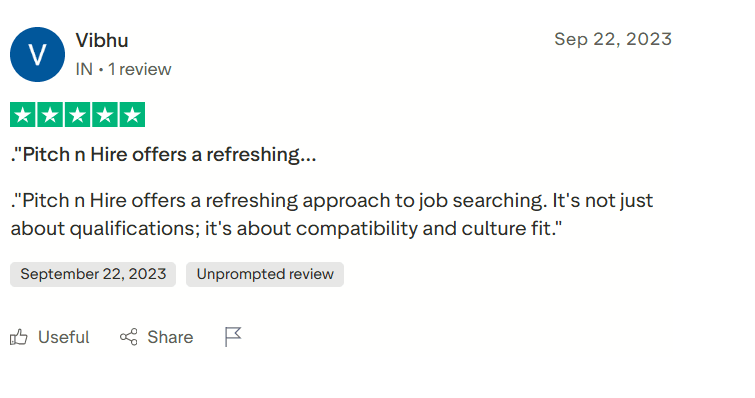
Customer Name: Vibhu
Location: India
“Pitch N Hire offers a refreshing approach to hiring. It focuses not just on resumes but also on culture fit and candidate compatibility. The platform is modern and very easy to navigate.”
Check Pitch N Hire customer feedback on Trustpilot
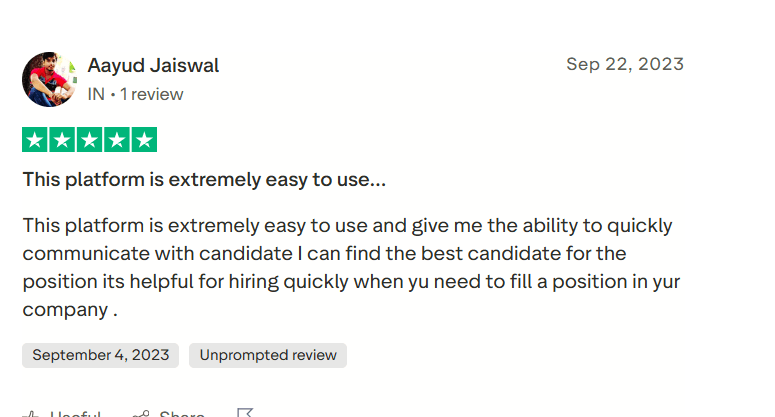
Customer Name: Aayud Jaiswal
Location: India
“The platform is extremely easy to use and helps me connect with candidates quickly. Pitch N Hire simplifies hiring and saves a lot of time compared to traditional recruitment tools.”
Read Pitch N Hire user experiences on Trustpilot
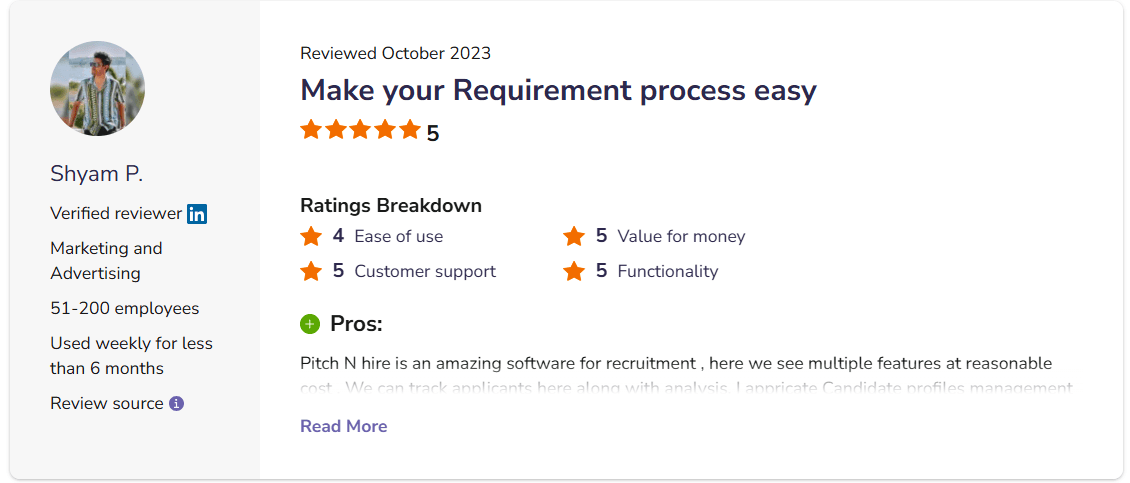
Customer Name: Shyam P.
Industry: Marketing & Advertising
“Pitch N Hire makes the entire recruitment process easier. From tracking applicants to analyzing hiring performance, everything is available in one dashboard. It’s a reliable recruitment platform.”
View Pitch N Hire ATS reviews on SoftwareAdvice
Customer Name: Amelia Grace
Company: PrideStaff
“The software is simple, user-friendly, and easy to navigate. The Pitch N Hire team is supportive and continuously improving the platform based on user feedback.”
Read Pitch N Hire software reviews on GoodFirms
Pitch N Hire Methodology
Job Requisition & Planning Start by defining the role requirements, including skills, experience level, qualifications, and cultural fit. Work with hiring managers to understand team needs and create a detailed job description.
2. Job Posting & Sourcing Post the position on your ATS (Applicant Tracking System), job boards, and social media. Use Pitch N Hire's platform to distribute listings across multiple channels simultaneously. Leverage employee referrals and passive candidate sourcing.
3. Application Screening Review incoming applications using automated screening tools to filter candidates based on keywords, qualifications, and experience. Create a shortlist of candidates who meet minimum requirements.
4. Initial Assessment Conduct phone or video screenings to assess basic qualifications, communication skills, and interest level. This is typically a 15-30 minute conversation to verify resume details and gauge cultural fit.
5. Skills Testing Administer relevant assessments such as technical tests, cognitive ability tests, or personality assessments. Use Pitch N Hire's assessment tools to evaluate candidates objectively.
6. Interview Rounds Conduct structured interviews with hiring managers and team members. This typically includes 2-3 rounds: HR interview, technical/functional interview, and final interview with senior leadership.
7. Reference Checks Contact previous employers or professional references to verify work history, performance, and character. Confirm the candidate's claims and gather additional insights.
8. Offer Management Prepare and extend a formal offer letter including compensation, benefits, start date, and terms. Negotiate if necessary and obtain signed acceptance.
9. Onboarding Once accepted, begin pre-boarding activities like paperwork, background checks, and system access setup. Create a structured onboarding plan for the new hire's first weeks.
Modern ATS Platforms Built for UK SMBs:

Next-Generation ATS Solutions – What to Look For
The best ATS UK market has evolved to serve small and medium-sized businesses with solutions that were previously only accessible to enterprises. Understanding what distinguishes modern platforms from legacy systems helps organizations make informed decisions.
UK-Specific Design Philosophy: Leading platforms are purpose-built for British recruitment rather than international systems retrofitted for UK markets. This means native understanding of:
- UK qualification frameworks (A-levels, BTECs, degrees, apprenticeships)
- British job board ecosystems (Reed, Totaljobs, CV-Library)
- UK employment law and compliance requirements
- Local hiring practices and candidate expectations
Affordability Without Feature Compromise: Modern affordable ATS software UK providers have disrupted traditional pricing models. Where enterprise systems start at £20,000+ annually, contemporary platforms deliver comparable core functionality for £1,200-5,000 per year. This democratization occurs through:
- Cloud infrastructure eliminating server costs
- Automated customer onboarding reducing support overhead
- Focus on SMB market achieving scale through volume
- Open API architectures reducing custom integration costs
Implementation Methodology That Works: Traditional ATS implementations notoriously take 3-6 months and require extensive consulting. Modern AI-powered ATS UK platforms have revolutionized this process:
Phase 1: Foundation (Week 1)
- Initial configuration and company branding setup
- User account creation and permission structures
- Integration connections to existing tools (HRIS, calendar systems)
- Data migration from spreadsheets or previous systems
Phase 2: Customization (Week 2)
- Custom workflow configuration for different roles
- Email template personalization
- Interview scorecard development
- Job description template library creation
Phase 3: Training & Launch (Week 3)
- Live training sessions for recruiters and hiring managers
- Test job postings and candidate processing
- Go-live support with dedicated implementation specialist
- Documentation handover and resource access
This compressed timeline succeeds because modern platforms prioritize intuitive design requiring minimal training rather than complex systems demanding extensive education.
Compliance by Design Rather Than Add-On: The most sophisticated recruitment software UK solutions embed GDPR, Equality Act, and Right to Work compliance into fundamental architecture. Rather than treating regulatory requirements as features to be enabled, these systems make non-compliance technically difficult:
- Consent capture is mandatory before data processing
- Retention policies enforce automatically
- Audit logs capture all data access by default
- Bias detection scans job descriptions before posting
Advanced Features in Modern UK Recruitment Platforms

Intelligent AI Resume Screening Architecture: Contemporary AI recruitment software UK goes far beyond keyword matching. Advanced systems use:
Natural Language Processing: Understanding semantic meaning rather than exact phrases. When a job requires "project management experience," the AI recognizes candidates mentioning "coordinated cross-functional initiatives" or "led delivery teams" as potentially qualified even without using the exact terms.
Contextual Skill Extraction: Rather than relying on candidates to list every skill explicitly, machine learning models infer capabilities from experience descriptions. A candidate managing Google Analytics implementations demonstrates proficiency in data analysis, technical tool adoption, and marketing measurement—skills they might not explicitly list.
Transparent Scoring Methodology: Unlike black-box algorithms, leading platforms explain scoring decisions. Recruiters see exactly why candidates received specific scores—which qualifications matched, which were missing, and which experiences proved most relevant. This transparency builds trust while allowing human override when context matters.
Bias Detection & Mitigation: AI systems trained on diverse datasets and regularly audited for disparate impact actively flag potential discrimination. If the algorithm consistently scores certain demographic groups lower, administrators receive alerts prompting investigation and recalibration.
Comprehensive UK Job Board Integration Strategy: ATS with UK job board integration must go beyond basic posting capabilities:
Intelligent Multi-Channel Distribution: Leading systems analyze which boards generate quality applicants for specific role types, automatically adjusting distribution strategy. Technical roles might perform best on CWJobs and Stack Overflow, while retail positions get better response from Indeed and local job centers.
Centralized Application Management: Regardless of where candidates apply—company career site, Reed, LinkedIn, or employee referral—all applications funnel into a unified candidate database. This prevents duplicate processing and ensures consistent evaluation.
Source Attribution & ROI Tracking: Modern platforms track cost-per-applicant and cost-per-hire across all sources, enabling data-driven recruitment marketing optimization. Organizations discover which £500 job board investment generates better results than £5,000 alternatives.
Automated Job Board Formatting: Each platform has unique requirements for job descriptions, company information, and application processes. Sophisticated UK recruitment platform systems automatically format posts for each board's specifications, eliminating manual reformatting.
Integrated Video Interview Capabilities: ATS with video interview software UK represents significant efficiency gains:
One-Way Video Screening: Candidates record responses to standardized questions on their schedule. Recruiters review submissions asynchronously, evaluating 10-15 candidates in the time traditional phone screens accommodate 2-3. This approach particularly benefits high-volume hiring while improving candidate experience by eliminating scheduling coordination.
Live Interview Tools: Built-in video conferencing with recruitment-specific features:
- Structured interview guides keeping conversations consistent
- Real-time scorecards for immediate feedback capture
- Automatic recording storage linked to candidate profiles
- Multi-interviewer support with separate evaluation forms
Interview Intelligence: Advanced systems transcribe interviews automatically, extract key discussion points, and flag potential red flags or impressive moments for hiring team review.
Branded Career Page Builders: Professional recruitment marketing no longer requires web development expertise:
No-Code Customization: Drag-and-drop editors allow HR teams to create career sites matching brand guidelines without technical skills. Custom layouts, color schemes, imagery, and content blocks provide enterprise-level presentation.
SEO Optimization Built-In: Career pages generated by leading platforms include proper schema markup, meta descriptions, and site structure that indexes well in search engines. This organic traffic supplements paid job board postings.
Dynamic Job Feeds: Rather than manually updating career sites, automated systems pull current openings from the ATS database, ensuring accuracy while reducing administrative burden.
Mobile-First Design: With 60%+ of job seekers browsing opportunities on phones, responsive career pages that provide excellent mobile experiences are essential rather than optional.
Core Features of Modern ATS Systems UK in 2026

AI Applicant Tracking System UK Capabilities
Artificial intelligence has transformed ATS systems UK from passive databases into active recruiting assistants:
Advanced CV Parsing Accuracy: Modern AI-powered ATS UK platforms achieve 95%+ parsing accuracy even with unconventional CV formats. They understand British qualifications (A-levels, BTECs, NVQs), recognize UK industry certifications, and extract information from PDFs, Word documents, and even scanned images. This eliminates manual data entry and ensures consistent candidate records.
Intelligent Skill Matching: Rather than simple keyword matching, AI algorithms understand semantic relationships between skills. A candidate who lists "Google Analytics" demonstrates proficiency in "web analytics" and "data analysis" even without explicitly mentioning those terms. This contextual understanding dramatically reduces false negatives where qualified candidates are rejected due to vocabulary differences.
Predictive Candidate Scoring: Machine learning models trained on your historical hiring data identify patterns in successful employees. The system learns which combination of experience, skills, and background characteristics correlate with high performance and long tenure, then applies these insights to score new applicants. This reduces recruiter bias and surfaces hidden gem candidates who might otherwise be overlooked.
Automated Pre-Screening: Conversational AI chatbots can conduct preliminary candidate screenings, asking qualification questions, assessing salary expectations, and evaluating work authorization status. This happens 24/7 without recruiter involvement, dramatically accelerating the early screening phase while improving candidate experience through immediate engagement.
Cloud-Based ATS UK for Remote & Hybrid Teams
The shift to distributed work has made cloud-based ATS UK solutions essential rather than optional:
Universal Accessibility: Recruiters, hiring managers, and interviewers access the platform from anywhere with internet connectivity. Whether your HR team works from Manchester, London, or home offices across the UK, everyone operates from the same real-time data. This eliminates the version control problems inherent in email-based recruitment.
Elastic Scalability: Cloud infrastructure allows ATS platforms UK to handle seasonal hiring surges without performance degradation. Retailers hiring hundreds of temporary workers for Christmas or universities processing thousands of applicants in clearing periods can do so without system slowdowns or expensive infrastructure upgrades.
Enterprise-Grade Security: Reputable UK recruitment platform providers implement bank-level data security: end-to-end encryption, regular penetration testing, ISO 27001 certification, and UK data center hosting to ensure GDPR compliance. Candidate data receives far better protection than it would on local servers or spreadsheets.
Automatic Updates: Cloud-based systems receive continuous improvements and regulatory updates automatically. When UK employment law changes or new compliance requirements emerge, your ATS adapts without requiring manual updates or expensive consulting fees.
Mobile-Friendly ATS UK for Recruiters & Candidates

Mobile optimization has moved from nice-to-have to mandatory for effective recruitment software UK:
Mobile Application Experience: Today's candidates expect to apply for jobs from their phones during commutes or lunch breaks. Mobile-friendly ATS UK platforms offer streamlined application processes optimized for small screens—one-click apply with LinkedIn profiles, resume uploads from cloud storage, and minimal form fields. Poor mobile experiences can eliminate up to 60% of potential applicants.
Recruiter Mobile Apps: Hiring managers and recruiters need access to candidate information on the go. Native mobile apps allow instant candidate review, interview feedback submission, and communication from anywhere. This responsiveness dramatically improves candidate experience and accelerates hiring timelines.
Faster Response Rates: Push notifications alert recruiters to urgent actions—top candidates applying, interview confirmations needed, or offer acceptance deadlines approaching. This immediacy prevents talented candidates from accepting competing offers while waiting for your response.
Enhanced Candidate Engagement: SMS integration within UK hiring software enables recruiters to reach candidates through their preferred communication channel. Text message open rates (98%) far exceed email (20%), ensuring important updates don't go unnoticed.
Legal & Compliance Requirements for ATS Software UK

GDPR Compliant ATS UK – Mandatory Requirements
Operating recruitment software in the UK without proper GDPR compliance exposes organizations to severe financial and reputational risks. A GDPR compliant ATS UK must implement these mandatory capabilities:
Explicit Candidate Consent Management: The system must capture clear, informed consent before processing any personal data. This means candidates must actively opt-in (pre-checked boxes are illegal) and understand exactly how their information will be used. Your applicant tracking system UK should automatically present compliant consent forms and maintain timestamped records of acceptance.
Defined Data Retention Policies: GDPR requires that personal data isn't kept longer than necessary. Your ATS must enforce configurable retention rules that automatically flag candidates for deletion after specified periods (typically 6-12 months after recruitment conclusion). Manual tracking of hundreds or thousands of candidate records makes compliance impossible—automation is essential.
Right to Erasure Functionality: When candidates request data deletion, organizations must comply within 30 days unless legitimate grounds for retention exist. GDPR compliant applicant tracking system UK platforms provide self-service deletion requests and automated workflows that notify recruiters, remove data across all system components, and generate compliance certificates proving deletion occurred.
Data Portability Tools: Candidates have the right to receive their personal data in machine-readable formats. Your ATS should generate comprehensive data exports on demand, packaging all information held about an individual in commonly accessible formats like PDF or CSV.
Breach Notification Systems: If a data breach occurs, UK organizations must notify the ICO within 72 hours. Robust ATS GDPR requirements UK include security monitoring, breach detection, and incident response workflows that help meet these aggressive timelines.
Privacy by Design Architecture: The most sophisticated recruitment technology UK platforms embed privacy into their fundamental design rather than bolting it on afterward. This includes data minimization (only collecting necessary information), pseudonymization where possible, and default privacy settings that require users to actively expand data access rather than restrict it.
Non-compliance isn't theoretical—the ICO issued £42 million in GDPR fines to UK organizations in 2024 alone, with recruitment firms representing a significant portion of violations.
Equality Act & Right to Work Verification in ATS Systems UK

Beyond data privacy, ATS systems UK must support fair, non-discriminatory hiring practices:
Automated Bias Detection Tools: Advanced equality act recruitment software UK uses AI to flag potentially discriminatory language in job descriptions before posting. Phrases that might inadvertently discourage protected groups (age references like "digital native," gendered language, or unnecessary physical requirements) are identified and suggested alternatives provided.
Blind Screening Capabilities: To reduce unconscious bias, modern platforms can hide candidate information unrelated to qualifications during initial screening—names that might indicate ethnicity or gender, graduation dates suggesting age, or postal codes implying socioeconomic background. This ensures evaluation focuses purely on skills and experience.
Comprehensive Diversity Reporting: Equality Act compliance requires monitoring recruitment outcomes across protected characteristics. Your ATS software UK should generate detailed diversity reports showing representation at each hiring stage—who applies, who gets screened in, who interviews, and who receives offers. This data helps identify where bias might exist in your process.
Right to Work Verification Integration: UK employers face civil penalties up to £20,000 per illegal worker. Modern right to work verification ATS systems integrate with government verification services, creating clear audit trails that demonstrate due diligence. Digital document verification, automated expiry date tracking for time-limited work permission, and suspicious document detection protect organizations from compliance failures.
Structured Interview Tools: Unstructured interviews introduce significant bias risk. Leading recruitment system UK platforms provide interview scorecards with standardized questions, forcing evaluators to assess all candidates against identical criteria. This structure creates defensible hiring decisions while improving quality of hire.
Accessible Application Processes: Equality Act obligations extend to providing reasonable adjustments for disabled applicants. Your ATS should meet WCAG 2.1 AA accessibility standards at minimum, ensuring candidates using screen readers, keyboard navigation, or other assistive technologies can apply successfully.
ATS Systems UK Market Trends & Predictions for 2026

UK Applicant Tracking Trends 2026
The UK applicant tracking trends 2026 reveal where recruitment technology is heading:
AI-First Architecture Becomes Standard: While AI features were differentiators in 2022-2023, they're now baseline expectations. Every competitive AI recruitment software UK platform offers intelligent resume screening, automated candidate communication, and predictive analytics. The differentiation has shifted to which AI capabilities are most sophisticated and accurate.
Video Interview Platform Consolidation: Separate video interviewing tools are being absorbed into comprehensive ATS platforms UK. Integrated solutions allow recruiters to schedule video interviews, conduct them, and evaluate recordings within a single interface. This consolidation reduces software costs while improving data connectivity—interview performance scores automatically feed into candidate profiles.
Recruitment Marketing Integration: The line between ATS and recruitment marketing platforms has blurred. Modern recruitment technology UK encompasses employer branding, career site management, programmatic job advertising, and candidate relationship management alongside traditional ATS functions. This unified approach creates cohesive candidate journeys from first brand exposure through job offer.
Skills-Based Hiring Acceleration: Traditional qualification filters (degree requirements, years of experience) are giving way to skills-based assessment. AI-powered ATS UK platforms now offer integrated skills testing, work sample evaluations, and competency-based screening that focus on what candidates can do rather than their educational pedigree.
Candidate Expectations Drive Innovation: The talent shortage has shifted power dynamics toward candidates. UK recruitment platform providers innovate relentlessly around candidate experience—one-click applications, transparent salary information, real-time status updates, and personalized communication. Poor candidate experience is no longer just a brand risk; it's an existential threat to talent acquisition.
Predictive Hiring Analytics: Beyond reporting what happened, cutting-edge recruitment automation software UK predicts what will happen. Which sourcing channels will deliver your next hire? How long will it take to fill this role? What salary offer will this candidate accept? Machine learning models trained on your historical data answer these questions with increasing accuracy.
Why AI Recruitment Software UK Is Becoming the Standard

The rapid adoption of AI recruitment software UK isn't hype—it's driven by measurable business impact:
Dramatic Cost Efficiency: AI automation reduces cost-per-hire by 35-50% according to 2025 CIPD research. When systems handle resume screening, candidate communications, and interview scheduling automatically, recruitment teams accomplish more with fewer resources. For SMBs operating on tight budgets, these savings often fund the ATS investment entirely within the first year.
Time-to-Hire Compression: Manual screening of 200+ applications for a single role can consume 15-20 recruiter hours. AI applicant tracking system UK platforms complete the same task in minutes, with comparable or superior accuracy. This speed advantage is particularly crucial in competitive talent markets where top candidates receive multiple offers quickly.
Quality of Hire Improvements: Perhaps most significantly, AI improves hiring outcomes. By eliminating unconscious bias, evaluating candidates against objective criteria, and learning from historical success patterns, intelligent systems help organizations identify candidates who succeed and stay longer. The average quality-of-hire score improves 23% within 12 months of AI ATS implementation, reducing costly mis-hires.
Scalability Without Proportional Cost: Traditional recruitment requires roughly one recruiter per 50 hires annually. AI-powered ATS UK solutions break this linear relationship. Organizations can double hiring volume without doubling recruitment headcount, making rapid growth sustainable.
Competitive Necessity: The final driver is simpler competitors are already using these tools. Companies still relying on manual processes lose top candidates to organizations that respond faster, communicate better, and offer superior experiences. In talent acquisition, technological parity is essential for survival.
Understanding Modern ATS Pricing & ROI for UK Businesses

Transparent Subscription Models: The affordable ATS software UK market has moved toward clear, predictable pricing structures:
Tiered Pricing Approaches:
- Startup Tier (£99-199/month): 1-3 users, unlimited jobs, basic features, standard support
- Growth Tier (£299-499/month): 5-10 users, advanced AI, premium integrations, priority support
- Business Tier (£699-999/month): Unlimited users, white-glove support, custom workflows, dedicated account management
Per-Employee Alternative: Some providers charge based on company size (£2-5 per employee monthly), which scales naturally with organizational growth.
What's Typically Included:
- Core ATS functionality (job posting, resume parsing, candidate tracking)
- AI screening and candidate matching
- Standard job board integrations (major UK platforms)
- Email automation and templates
- Basic reporting and analytics
- Mobile applications
- GDPR compliance tools
- Standard customer support
Common Additional Costs:
- Premium job board credits (Indeed sponsored posts, LinkedIn job slots)
- Advanced integrations (background checks, assessment tools)
- Custom implementation services beyond standard setup
- White-label career site domain hosting
- Additional user licenses beyond plan limits
Cost Comparison: Modern vs Enterprise ATS: Understanding relative value helps contextualize recruitment software UK pricing:
Traditional Enterprise Platforms:
- Annual licensing: £20,000-50,000
- Implementation fees: £10,000-30,000
- Training programs: £3,000-8,000
- Ongoing support: £5,000-10,000 annually
- Total Year 1: £38,000-98,000
- Total Year 2+: £25,000-60,000 annually
Modern SMB-Focused Platforms:
- Annual subscription: £3,600-12,000
- Implementation: Included or £1,000-3,000
- Training: Included in subscription
- Support: Included in subscription
- Total Year 1: £4,600-15,000
- Total Year 2+: £3,600-12,000 annually
For most SMBs making 10-100 hires annually, modern platforms deliver 75-85% of enterprise functionality at 20-30% of the cost—a compelling value proposition driving rapid market adoption.
Demonstrated ROI Methodology: Quality AI-powered ATS UK platforms generate measurable returns:
Time-to-Hire Reduction:
- Manual screening: 15-20 hours per role
- AI-assisted screening: 2-3 hours per role
- Savings: 12-17 hours × recruiter hourly cost × annual hires
- For 50 annual hires at £35/hour: £21,000-29,750 annual savings
Agency Fee Reduction:
- Typical agency placement: 20-25% of first-year salary
- Average cost per agency hire: £8,000-15,000
- Reducing agency reliance from 40% to 10% of hires saves: £120,000-225,000 annually on 50 hires
Quality of Hire Improvements:
- Reduced turnover (23% improvement): £4,000-8,000 per prevented departure
- Better performance (15% productivity gain): Difficult to quantify but substantial
- Improved cultural fit: Reduces team friction and management burden
Administrative Efficiency:
- Automated scheduling saves 3-5 hours per hire
- Standardized communications reduce errors and delays
- Centralized data eliminates duplicate work
Conservative ROI Example (50 annual hires, £10,000 ATS investment):
- Time savings: £22,000
- Reduced agency fees (5 fewer placements): £50,000
- Quality improvements (2 prevented turnovers): £10,000
- Total annual benefit: £82,000
- Net ROI: 720% first year, higher in subsequent years
This explains why best ATS UK adoption has accelerated dramatically—the business case is compelling even for conservative organizations.
ATS Software Comparison UK – Choosing the Right Platform

Best ATS Systems UK for Startups
Unique Startup Requirements: Early-stage companies face distinct recruitment challenges that differentiate their best ATS systems UK for startups needs from larger organizations:
- Limited Budget: Venture funding is precious. Systems must deliver maximum value without enterprise price tags.
- Small HR Teams: Often a single person handling recruitment alongside other responsibilities means software must be exceptionally intuitive.
- Rapid Growth Uncertainty: Today's 10-person startup may be 100 people next year. Solutions must scale without requiring platform changes.
- Strong Employer Branding Needs: Competing against established companies for talent requires professional presentation and seamless candidate experiences.
Ideal Startup ATS Characteristics:
Quick Setup & Minimal Training: Startups can't afford 2-month implementations. Look for cloud-based ATS UK platforms operational within 1-2 weeks with intuitive interfaces requiring minimal training.
All-Inclusive Pricing: Avoid platforms charging separately for job board postings, career sites, or basic features. Startups need predictable costs. Pitch N Hire and similar solutions offering comprehensive functionality in base pricing provide better value.
Growth Accommodation: Ensure the system handles your current 5 annual hires but scales smoothly to 50+ without requiring migration. Flexible user licensing and unlimited job postings support unpredictable growth.
Strong Candidate Experience: Startups compete for talent against better-known brands. Mobile-friendly applications, branded career pages, and responsive communication help level the playing field.
Recommended Focus: Startups should prioritize ease of use, rapid implementation, and comprehensive base features over advanced enterprise capabilities they won't use for years.
ATS for Small & Mid-Sized Businesses UK
SMB-Specific Needs: ATS for small business UK and ATS for mid-sized companies UK share some startup concerns but face additional complexity:
- Department Diversity: Hiring spans technical, sales, operations, and administrative roles requiring flexible workflow configuration.
- Distributed Decision-Making: Multiple hiring managers need system access without becoming ATS experts.
- Compliance Rigor: Established companies face greater regulatory scrutiny and can't risk GDPR violations.
- HRIS Integration: Unlike startups often using spreadsheets, SMBs typically have existing HR systems requiring integration.
Ideal SMB ATS Characteristics:
Customizable Workflows: Different departments hire differently. Look for platforms allowing customized approval chains, interview processes, and evaluation criteria without requiring coding skills.
Robust Reporting: SMBs need data to optimize hiring spend and demonstrate HR effectiveness to leadership. Comprehensive analytics showing time-to-hire, cost-per-hire, source effectiveness, and diversity metrics are essential.
Strong Integration Capabilities: Your recruitment system UK should connect seamlessly with existing tools—HRIS platforms like BambooHR, background check providers, assessment platforms, and payroll systems. Pre-built integrations beat custom API development.
Scalable User Management: As teams grow, adding users should be simple and affordable. Per-user pricing models work well if rates are reasonable; unlimited user options suit companies expecting significant growth.
Compliance Assurance: SMBs lack dedicated compliance teams. Your GDPR compliant ATS UK should handle regulatory requirements automatically rather than requiring manual policy enforcement.
Recommended Solutions: Platforms like modern UK-focused ATS providers, Greenhouse, and Lever offer strong SMB value propositions, balancing capability with usability. Many of these systems provide free trials allowing hands-on evaluation before commitment.
Enterprise ATS Software UK – When Do You Need It?
Enterprise Threshold Indicators: Not every large company needs enterprise ATS software UK, but certain characteristics indicate enterprise-grade requirements:
- Multi-Location Operations: Hiring across dozens of UK locations or internationally requires sophisticated location management and localization.
- High Hiring Volume: Organizations making 500+ annual hires need industrial-strength infrastructure preventing performance degradation during peak periods.
- Complex Compliance Requirements: Regulated industries (financial services, healthcare, defense) face specialized compliance needs beyond standard GDPR.
- Advanced Integration Needs: Enterprises typically run complex tech stacks requiring custom integrations, single sign-on, and sophisticated security controls.
- Dedicated HR Technology Teams: Enterprise platforms require ongoing administration, configuration, and optimization—resources small companies lack.
Enterprise ATS Distinguishing Features:
Advanced Security & Compliance: SOC 2 Type II certification, custom data retention policies, field-level permission controls, and comprehensive audit logging suit enterprises facing regulatory scrutiny.
Unlimited Customization: Workflow engines allowing complex, rule-based routing; custom fields and objects; API access for bespoke integrations. Enterprise platforms are toolkits rather than fixed products.
White-Glove Implementation: Dedicated implementation teams, change management consulting, custom training programs, and ongoing strategic support justify higher costs.
Enterprise Reporting & Analytics: Advanced data warehousing, predictive analytics, custom report builders, and executive dashboards provide insights simple reporting can't match.
Leading Enterprise Options: Workday Recruiting, Oracle Taleo, SAP SuccessFactors, and iCIMS dominate the enterprise ATS software UK market. These platforms start around £50,000 annually and can reach £200,000+ for large, complex deployments.
When SMB Solutions Suffice: Interestingly, many mid-market companies (500-2,000 employees) find top ATS systems UK like Greenhouse or Lever meet their needs at 60-70% lower cost than traditional enterprise platforms. The enterprise label doesn't automatically mean you need enterprise pricing.
How to Choose ATS UK 2026

Comprehensive Decision Framework: Selecting the right ATS software UK requires systematic evaluation. Follow this step-by-step approach:
Step 1: Assess Your Hiring Volume & Complexity
Quantify Current & Projected Hiring:
- How many positions do you fill annually today?
- What's your 2-year growth projection?
- Is hiring seasonal or consistent?
- How many recruiters/hiring managers will use the system?
Evaluate Process Complexity:
- Do all roles follow similar hiring workflows or require customization?
- How many interview stages do typical processes include?
- Do you use assessment tests, work samples, or specialized screening?
This assessment determines whether you need startup-friendly simplicity or SMB/enterprise configurability.
Step 2: Define Compliance & Security Requirements
Regulatory Checklist:
- ✅ GDPR compliance features (data subject rights, retention policies, consent management)
- ✅ Equality Act support (blind screening, diversity reporting, bias detection)
- ✅ Right to Work verification integration
- ✅ Data localization (UK data center hosting)
- ✅ Security certifications relevant to your industry
Risk Tolerance Assessment: Regulated industries (finance, healthcare) need more rigorous compliance features than typical SMBs. Be honest about your organization's risk profile.
Step 3: Establish Budget Parameters
Total Cost of Ownership Calculation:
- Software Subscription: Annual licensing costs
- Implementation: Setup, data migration, customization fees
- Training: Time investment converting team to new system
- Integration: Connecting to existing HR tech stack
- Ongoing Support: Premium support tiers if needed
ROI Expectations: Quality recruitment software UK should generate ROI within 6-12 months through reduced time-to-hire, lower agency fees, and improved hiring quality. If projected savings don't cover costs, reconsider whether you need an ATS or should focus on process improvements first.
Budget Realism: Expect £1,200-3,000 annually for affordable ATS software UK serving startups, £5,000-15,000 for robust SMB solutions, and £20,000+ for enterprise platforms.
Step 4: Compare Features Against Your Needs
Essential Feature Checklist:
- ✅ Resume parsing & candidate database
- ✅ UK job board integrations (Reed, Totaljobs, Indeed UK, CV-Library minimum)
- ✅ Email templates & automated communication
- ✅ Interview scheduling tools
- ✅ Collaborative hiring workflows
- ✅ Basic reporting (time-to-hire, source effectiveness)
- ✅ Mobile-friendly candidate applications
- ✅ GDPR compliance automation
Advanced Features to Evaluate:
- AI resume screening & candidate scoring (AI applicant tracking system UK capabilities)
- Video interview platform integration
- Career site builder for employer branding
- Employee referral management
- Assessment tool integrations
- Advanced analytics & predictive insights
- Multi-language support for international hiring
Feature Prioritization: Distinguish between must-haves (deal-breakers if absent) and nice-to-haves (valuable but not essential). This prevents feature bloat from driving decisions toward expensive platforms you don't fully utilize.
Step 5: Test Usability & User Experience
Hands-On Evaluation:
Request Live Demos: Not recorded product tours, but interactive sessions where you navigate the system with real scenarios from your hiring process.
Free Trials: Most quality ATS platforms UK offer 14–30-day trials. Use them to:
- Create actual job postings
- Process sample resumes
- Invite hiring managers for feedback
- Test mobile experience
- Evaluate reporting capabilities
Candidate Experience Testing: Apply to test jobs yourself using various devices. Poor candidate experience directly impacts your ability to attract talent—this isn't secondary.
Team Input: Include actual system users (recruiters, hiring managers, coordinators) in evaluation. Executive decisions made without end-user input often result in unused systems.
Step 6: Verify Integration Capabilities
Current Tech Stack Audit:
- What HRIS/payroll system do you use?
- What communication tools does your team prefer?
- Do you use background check or assessment providers?
- What calendar system do you operate on?
Integration Verification: Confirm your recruitment system UK offers native integrations with tools you currently use. API availability provides flexibility but requires development resources—pre-built connectors are preferable.
Step 7: Evaluate Vendor Support & Resources
Support Assessment Criteria:
- Availability: 24/7 vs business hours support
- Channels: Phone, chat, email options
- Response Times: SLA commitments for different priority levels
- UK Presence: Local support teams familiar with British employment law and practices
- Training Resources: Documentation quality, video tutorials, certification programs
Long-Term Partnership Indicators: ATS selection is a 3-5 year commitment. Evaluate vendor stability, product roadmap transparency, user community engagement, and customer retention rates.
Step 8: Review Customer References & Testimonials
Due Diligence:
- Read Reviews: G2, Capterra, Trustpilot reviews from UK customers specifically
- Request References: Speak with 2-3 current customers in similar industries/sizes
- Case Studies: Review documented results from comparable organizations
Red Flags to Watch:
- Consistently poor customer service reviews
- Complaints about hidden fees or difficult cancellation
- Negative feedback about implementation processes
- Reports of significant downtime or performance issues
Following this structured how to choose ATS UK 2026 framework ensures your selection aligns with actual needs rather than marketing promises or feature checklists that look good but don't match your recruitment reality.
FAQs
Do ATS Platforms UK Support Video Interviews?
Modern ATS platforms UK increasingly include integrated video interviewing, though implementation varies:
Integration Approaches:
Native Built-In Video (ATS with video interview software UK): Platforms like Pitch N Hire offer complete video solutions within the ATS interface. This includes:
- One-way video screening (candidates record responses to standardized questions)
- Live video interviews with built-in scorecards
- Automatic recording storage linked to candidate profiles
- Interview sharing for hiring team collaboration
Third-Party Integrations: Some recruitment system UK platforms integrate with specialized tools like Spark Hire or VidCruiter, requiring separate subscriptions but offering more advanced video capabilities.
Video Platform Connections: Basic systems connect with Zoom, Microsoft Teams, or Google Meet for scheduling but don't offer recruitment-specific features like structured interview guides or evaluation scorecards.
Advantages of Integrated Video:
- Single login for all recruitment activities
- Interview performance data connected to candidate profiles
- Streamlined scheduling without multiple tools
- Consistent candidate experience
- Lower total software costs
When evaluating UK hiring software, confirm video capabilities match your interview process. High-volume hiring particularly benefits from one-way video screening that allows asynchronous candidate evaluation.
Is AI Recruitment Software UK Accurate & Fair?
AI recruitment software UK accuracy and fairness depend heavily on implementation quality and organizational oversight. Here's what research shows:
Accuracy Levels:
- Resume Parsing: Top AI-powered ATS UK systems achieve 95%+ accuracy extracting information from CVs, significantly outperforming manual data entry
- Skill Matching: Semantic understanding allows AI to identify qualified candidates who use different terminology, reducing false negatives by 40-60%
- Candidate Scoring: When trained on quality historical data, AI predictions correlate with eventual hire success at statistically significant levels
Fairness Considerations:
Potential Bias Sources:
- Training data reflecting past discriminatory hiring patterns
- Proxy discrimination (using factors correlated with protected characteristics)
- Lack of transparency in decision-making logic
Bias Mitigation Strategies:
- Regular algorithmic audits checking for disparate impact
- Diverse training datasets representing protected groups fairly
- Explainable AI showing reasoning behind candidate scores
- Human oversight maintaining final decision authority
- Continuous monitoring comparing AI recommendations to actual hiring outcomes across demographics
UK Regulatory Environment: The Equality and Human Rights Commission guidance states that AI recruitment automation software UK must not produce discriminatory outcomes. Organizations using AI bear responsibility for ensuring fairness even if algorithms come from third-party vendors.
Best Practices:
- Choose AI applicant tracking system UK providers offering bias detection features
- Maintain human review of AI recommendations
- Monitor hiring outcomes across protected characteristics
- Document AI decision-making processes for potential discrimination claims
- Regularly retrain models on updated, diverse data
Quality AI recruitment software UK like Pitch N Hire improves fairness by eliminating inconsistent human judgment while providing transparency that allows bias detection and correction. However, AI is a tool requiring thoughtful implementation—not a magic solution guaranteeing perfect fairness.
Final Verdict – Best ATS Systems UK for 2026
The transformation of UK recruitment in 2026 has made ATS systems UK essential infrastructure rather than optional efficiency tools. With talent shortages persisting, compliance requirements intensifying, and candidate expectations rising, organizations clinging to manual hiring processes face insurmountable competitive disadvantages.
Key Takeaways for UK Employers:
ATS Investment Returns Are Measurable: Organizations implementing quality recruitment software UK consistently report 35-50% reductions in time-to-hire, 40-60% decreases in cost-per-hire, and significant improvements in hiring quality. These aren't marginal gains—they're transformative outcomes that directly impact business growth and competitiveness.
Compliance Isn't Optional: GDPR violations, equality act breaches, and right to work failures carry severe financial and reputational penalties. Attempting manual compliance with hundreds or thousands of candidates is unrealistic. GDPR compliant ATS UK platforms automate regulatory requirements, dramatically reducing legal risk.
AI Capabilities Are Now Standard: The question isn't whether to adopt AI recruitment software UK but which implementation best fits your needs. AI resume screening, candidate matching, and predictive analytics are baseline features in competitive platforms, not premium add-ons.
Candidate Experience Directly Impacts Hiring Success: In talent-scarce markets, every friction point in your application process eliminates qualified candidates. Mobile optimization, transparent communication, and professional presentation aren't nice-to-haves—they're recruitment necessities.
Right-Sized Solutions Exist for All Organizations: Whether you're a five-person startup or a 5,000-employee enterprise, appropriate ATS platforms UK exist at accessible price points. The startup excuse of "we're not big enough for an ATS" no longer holds—modern cloud-based ATS UK solutions start under £100/month.
About This Guide: This comprehensive resource on ATS systems UK was created to help British employers navigate the complex landscape of recruitment technology UK in 2026. We've combined market research, regulatory guidance, and practical implementation experience to provide actionable insights for organizations of all sizes. For more information about modern hiring solutions, explore vendor websites, read verified customer reviews, and conduct thorough evaluations before making your final selection.