
Reviewed by: Shivam Gupta, HR Specialist at Pitch N Hire

The hiring landscape has transformed dramatically, with businesses increasingly relying on data-driven recruitment decisions to build competitive teams. Yet despite the growing adoption of applicant tracking systems, confusion around ATS pricing remains one of the biggest obstacles preventing organizations from making informed buying decisions.
When evaluating applicant tracking system pricing, many companies focus solely on the monthly subscription cost—the sticker price—without considering the total cost of ownership. This narrow view often leads to budget overruns, unexpected fees, and ultimately, poor ROI from their hiring software investment.
Understanding ATS software pricing in 2025 is crucial whether you're a startup hiring your first employees, a mid-market company scaling rapidly, or an enterprise managing high-volume recruitment across multiple locations. The difference between choosing the right pricing model and the wrong one can mean thousands of dollars annually and significantly impact your ability to attract top talent efficiently.
This comprehensive guide breaks down everything you need to know about recruitment software pricing, from basic pricing models to hidden costs, ROI calculations, and how to choose a solution that delivers long-term value without breaking your budget.


ATS pricing refers to the cost structure that recruitment software vendors use to charge customers for access to their applicant tracking system platform. Unlike general HR software that may bundle various workforce management functions, applicant tracking system cost specifically covers the technology that helps organizations post jobs, manage candidates, streamline hiring workflows, and make better recruitment decisions.
Recruitment software pricing differs from broader HR technology pricing in several important ways. While HRMS platforms often charge based on total employee count, ATS solutions typically focus on active hiring needs—whether that's the number of recruiters using the system, active job openings, or a flat rate regardless of usage volume.
Understanding the core components of ATS cost helps buyers evaluate options more effectively. These components typically include:
The challenge with hiring software pricing is that vendors structure these components differently, making direct comparisons difficult. Some bundle everything into a single price, while others use modular pricing where each feature costs extra.

ATS pricing per user is one of the most common models in the recruitment software market. Under this structure, companies pay a recurring fee for each person who needs access to the system—typically recruiters, hiring managers, and HR administrators.
How per-user pricing works: Vendors charge a monthly or annual fee per active user, usually ranging from $50 to $500 per user depending on the features included and the vendor's target market. For example, a company with five recruiters might pay $150 per user monthly, resulting in a total ATS monthly cost of $750.
The advantages of per-user pricing include cost alignment with actual usage and the ability to scale licenses up or down as hiring teams change size. This model works well for organizations with a stable number of recruiters who need consistent system access.
However, limitations emerge as teams scale. The applicant tracking system cost can increase significantly when expanding hiring operations, and organizations must carefully track which users actually need full access versus read-only permissions. Some vendors restrict the number of hiring managers who can participate in the hiring process, creating workflow bottlenecks.
Best use cases for per-user pricing include small to mid-sized companies with predictable hiring team sizes and organizations that want tight control over system access and associated costs.
Flat rate ATS pricing provides a single monthly or annual fee regardless of how many users access the system or how many positions you're hiring for. This model has gained popularity among growing companies tired of calculating per-user costs as their teams expand.
Under flat-rate pricing, a company might pay $500 to $5,000 monthly depending on the feature tier and company size, but that rate remains constant whether five people or fifty people use the system. This creates exceptional cost predictability—a crucial benefit for financial planning.
The ATS software cost under flat-rate models particularly benefits organizations experiencing rapid growth. As you add recruiters, hiring managers, and HR team members, your subscription price stays the same. This eliminates the anxiety of budget increases when scaling hiring operations and encourages broader adoption across the organization.
Talent acquisition software pricing structured as flat-rate works best for companies with expanding hiring teams, organizations that want to involve many stakeholders in the hiring process, and businesses seeking predictable monthly expenses without usage calculations.
Some vendors structure ATS pricing around active job openings rather than users. Under this model, companies pay a base fee plus additional charges for each job posting they maintain in the system.
ATS pricing per job posting typically works as a tiered structure: a base subscription covering a certain number of job slots (perhaps 5-10 positions), with incremental costs for additional postings. For example, a vendor might charge $300 monthly for up to 10 active jobs, then $50 for each additional posting.
This pricing model aligns costs directly with hiring volume, making it ideal for seasonal hiring patterns or project-based recruitment. Companies ramping up hiring can increase job postings, while those in slower periods pay less by reducing active positions.
However, cost risks exist when hiring unexpectedly accelerates. The ATS cost can spike during high-growth periods, and some vendors charge separately for job board distribution, creating additional complexity in budget planning.
Best ATS pricing 2025 for seasonal businesses, agencies managing multiple client positions, and companies with highly variable hiring needs often follows the per-job-posting model.
Entry-level ATS pricing plans typically range from $50 to $300 monthly for small teams, making them accessible starting points for organizations new to recruitment automation. These affordable ATS software options provide core functionality without the advanced features that enterprise teams require.
What is ATS pricing at the basic tier? Expect foundational capabilities including resume parsing to extract candidate information, basic candidate tracking through hiring stages, email communication templates, job posting to the company career site, and simple reporting on recruiting metrics.
Basic tier solutions work best for startups, small businesses with 1-3 recruiters, and companies hiring fewer than 50 positions annually. These ATS pricing for startups options offer the essential tools to move beyond spreadsheets and email folders without overwhelming teams with complexity.
The limitation of basic pricing tiers involves feature restrictions. Advanced automation, sophisticated analytics, extensive integrations, and AI-powered capabilities typically require upgrading to higher tiers.
Mid-range ATS pricing tiers generally cost $300 to $1,500 monthly, targeting growing organizations that need more sophisticated recruitment capabilities. This tier represents the sweet spot for many companies—robust enough for scaling operations but not as expensive as enterprise solutions.
ATS software pricing at the professional level includes workflow automation to streamline repetitive tasks, interview scheduling tools that sync with calendars, advanced analytics and reporting dashboards, multiple job board integrations, collaboration features for hiring teams, customizable hiring pipelines, and mobile accessibility.
ATS pricing for small businesses experiencing growth often lands in this tier. The automation capabilities significantly reduce recruiter workload, while analytics provide visibility into hiring performance that basic tiers lack.
Organizations with 3-10 recruiters, companies hiring 50-500 positions annually, and businesses implementing structured hiring processes benefit most from professional tier recruitment software pricing.
Enterprise ATS pricing cost typically involves custom quotes rather than published pricing, with annual contracts ranging from $20,000 to $200,000+ depending on company size, hiring volume, and feature requirements. These solutions address the complex needs of large organizations conducting high-volume recruitment across multiple locations and departments.
ATS pricing for enterprises includes everything from lower tiers plus advanced security and compliance features, extensive customization capabilities, dedicated account management, API access for custom integrations, white-labeling options, unlimited user licenses, advanced AI and predictive analytics, and SLA-backed support.
Enterprise solutions serve ATS pricing for large organizations with 10+ recruiters, companies hiring 500+ positions annually, multinational organizations with complex compliance needs, and industries with stringent security requirements like finance, healthcare, and government.
The applicant tracking system pricing at this level reflects not just software access but comprehensive support, customization, and the vendor's commitment to your organization's long-term success.
When evaluating applicant tracking system cost options, organizations need partners that balance functionality, transparency, and value. Pitch N Hire ATS pricing addresses the common frustrations buyers experience with complex pricing structures and hidden fees.
Transparent pricing with no hidden fees forms the foundation of Pitch N Hire's approach. All costs are clearly itemized upfront, including base subscription, implementation, integrations, and support. This transparency allows organizations to budget accurately without surprise charges appearing after contracts are signed.
Flexible plans for startups, SMBs & enterprises ensure appropriate solutions regardless of organization size. Pitch N Hire ATS cost structures scale from affordable entry options for small teams to comprehensive enterprise capabilities—all on the same platform architecture. This eliminates costly migrations as companies grow.
AI-driven hiring without enterprise-level costs democratizes advanced recruitment technology. Pitch N Hire recruitment software includes AI-powered resume screening, candidate matching, and predictive analytics even at mid-tier pricing levels, while competitors reserve these features for premium enterprise plans costing significantly more.
Scalable architecture for long-term growth means the Pitch N Hire hiring software platform grows with your organization. Whether you're hiring 10 positions or 1,000 annually, the system handles increased volume without performance degradation or proportional cost increases that per-user models create.
Pitch N Hire applicant tracking system represents ROI-focused recruitment software pricing designed for organizations that want enterprise capabilities without enterprise complexity or costs.
The most visible component of ATS monthly cost is the base subscription fee—the recurring charge for platform access. However, understanding the nuances between monthly and annual subscriptions significantly impacts total spending.
Monthly subscriptions offer flexibility, allowing organizations to test solutions without long-term commitment. However, vendors typically charge 15-30% more for month-to-month agreements compared to annual contracts. A solution costing $400 monthly might cost only $3,600 annually ($300/month) with an annual commitment.
ATS annual pricing provides cost savings, price protection against mid-year increases, and often includes additional benefits like priority support or bonus features. The tradeoff involves upfront capital commitment and less flexibility to switch solutions if needs change.
When comparing ATS pricing comparison across vendors, always calculate the annual total cost and divide by 12 for accurate monthly comparisons, even if paying monthly.
ATS implementation cost represents one of the most commonly overlooked expenses when budgeting for recruitment software. These one-time charges cover the work required to configure the system, migrate existing data, and get your team operational.
Implementation fees vary dramatically based on vendor and complexity. Affordable ATS software aimed at small businesses might include basic setup in the subscription price, while enterprise solutions often charge $5,000 to $50,000+ for implementation.
ATS onboarding cost components include initial system configuration and branding, data migration from spreadsheets or previous ATS platforms, workflow setup tailored to your hiring process, integration configuration with existing tools, and administrator and recruiter training sessions.
Data migration deserves particular attention in ATS software total cost of ownership calculations. Moving candidate data, job templates, and historical hiring information requires careful planning. Some vendors charge per record migrated, while others include basic migration but charge for complex data transformation.
ATS integration cost can substantially increase your total investment beyond base subscription fees. Modern recruitment requires connecting your ATS with job boards, HRMS platforms, background check services, assessment tools, video interviewing platforms, and analytics systems.
ATS pricing with integrations varies widely. Some vendors bundle common integrations like LinkedIn, Indeed, and major HRMS platforms. Others charge separately for each connection—anywhere from $50 to $500+ monthly per integration.
ATS pricing premium features add on cost includes capabilities like AI candidate matching, advanced analytics dashboards, custom reporting, branded career sites, employee referral portals, and texting/SMS functionality.
When evaluating recruitment automation pricing, create a comprehensive list of required integrations and features, then request clear pricing for each. The lowest base subscription price often becomes expensive once you add necessary integrations.
Organizations using Pitch N Hire benefit from:
Kiran P. – Director (Small Business)
“Excellent platform for easy recruiting. Not too complicated, affordable, and the support team resolves issues quickly. Implementation was simple.”
Source:
Read Pitch N Hire customer review on G2

Bidyadhar B. – AWS Cloud Engineer (Mid-Market)
“Very good and user-friendly.”
Source:
Read Pitch N Hire customer review on G2
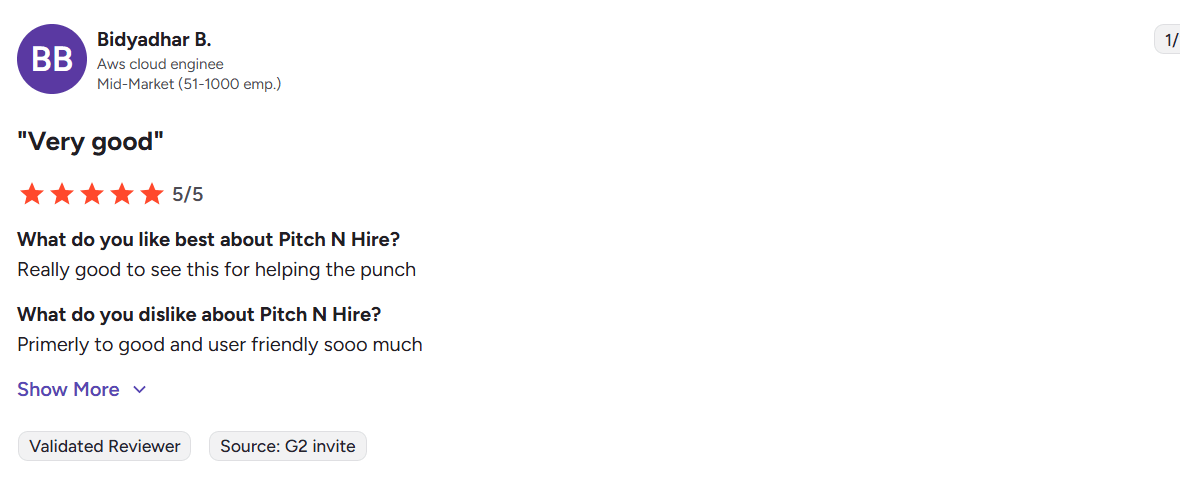
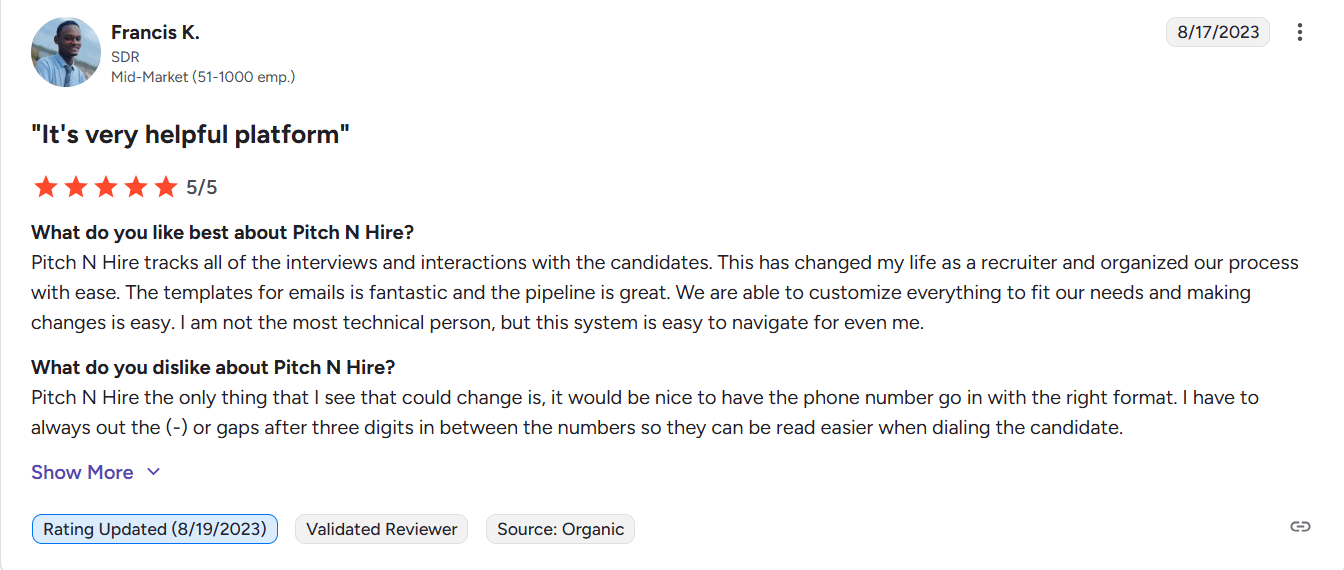
Francis K. – Sales Development Representative (Mid-Market)
“It tracks all interviews and interactions with candidates. Email templates are useful, and the pipeline is easy to navigate even for non-technical users.”
Source:
Read Pitch N Hire customer review on G2
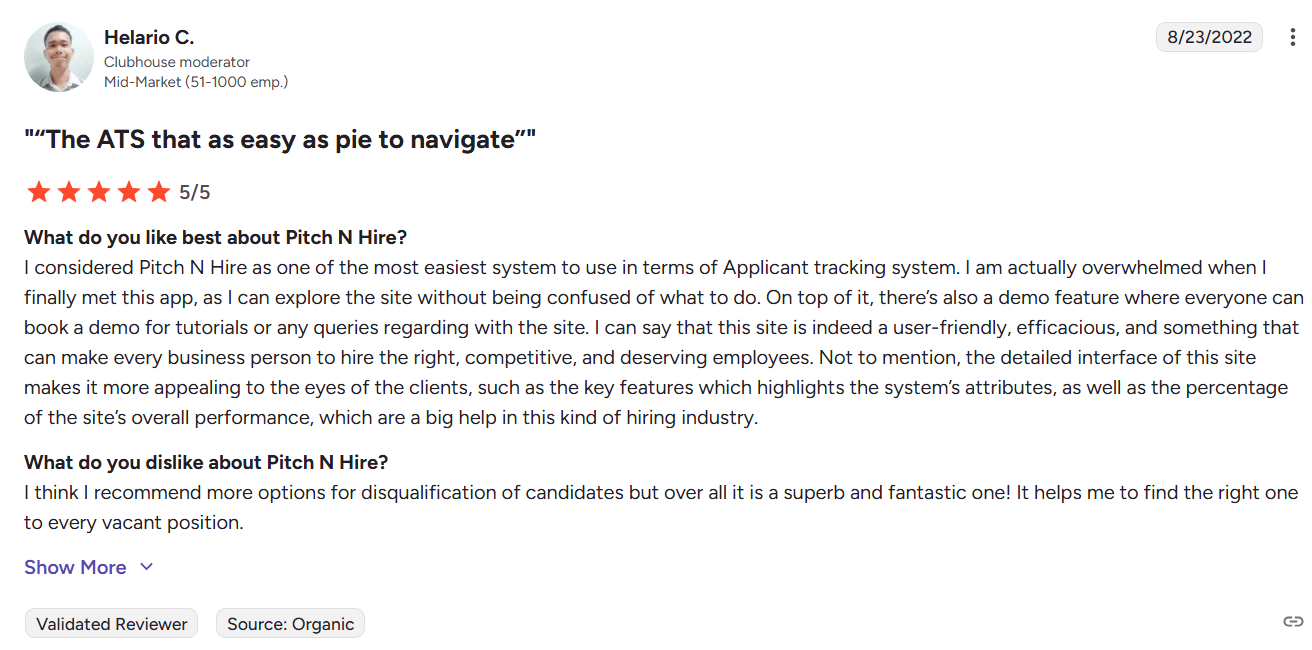
Helario C. – Clubhouse Moderator (Mid-Market)
“One of the easiest ATS systems to use. Intuitive and efficient.”
Source:
Read Pitch N Hire customer review on G2
Anant G. – Hiring Manager (Mid-Market)
“Excellent product with reasonable pricing that automates staffing workflows effectively.”
Source:
Read Pitch N Hire customer review on G2
Nikhil S. – Transcriptionist (Small Business)
“Perfect for job search and recruitment. The tagging and navigation features make the platform easy to use.”
Source:
Read Pitch N Hire customer review on G2
Vibhu – India
“Pitch N Hire offers a refreshing approach to job searching. It focuses on compatibility and culture fit rather than only resumes.”
Source:
Read Pitch N Hire customer review on Trustpilot

ATS pricing hidden costs frustrate buyers who discover unexpected charges after signing contracts. Understanding common hidden fees helps you negotiate better terms and budget accurately.
Extra user license costs often surprise companies. Some vendors advertise attractive per-user pricing but limit how many hiring managers can participate without purchasing additional licenses. Others charge more for administrators versus basic users.
Advanced analytics beyond standard reports frequently cost extra. ATS pricing with reporting and analytics at the comprehensive level might require premium tier upgrades or add-on purchases. Premium support represents another hidden cost—vendors may provide only email support in base packages, charging extra for phone support, dedicated account managers, or faster response times.
Data storage overages catch growing companies off-guard. Some cheap ATS software pricing includes limited storage, then charges when you exceed file upload caps. With candidates submitting resumes, cover letters, portfolios, and other documents, storage needs grow quickly.
ATS pricing explained requires understanding feature bundling approaches. Some vendors embrace all-inclusive pricing where almost everything lives within the base subscription. Others use modular pricing where core features come standard but most useful capabilities require add-on purchases.
Before committing to applicant tracking system pricing, ask vendors these critical questions:
ATS pricing transparent without hidden fees should be your goal. Vendors confident in their value proposition clearly itemize all costs and help you understand total ownership expenses upfront.
ATS monthly cost structures appeal to organizations valuing flexibility over cost savings. Paying month-to-month allows companies to test solutions thoroughly before committing long-term, making it ideal for organizations unsure which features they'll actually use or companies with uncertain hiring volumes.
Lower upfront financial risk represents a major advantage. Rather than committing $10,000+ for an annual contract, companies can start with a few hundred dollars monthly. This approach particularly benefits ATS pricing for startups with limited capital.
Monthly pricing works best for companies piloting ATS solutions for the first time, organizations in transitional periods with uncertain hiring needs, and businesses wanting the ability to switch solutions quickly if requirements change.
The tradeoff involves higher cumulative costs—typically 15-30% more annually than contracted pricing—and less pricing stability since vendors can increase rates more frequently.
ATS annual pricing delivers substantial cost savings for organizations confident in their vendor choice. Most providers offer discounts of 15-30% for annual commitments, representing thousands of dollars saved on mid-tier and enterprise solutions.
Price lock-in protects against mid-year rate increases. With annual contracts, your hiring software pricing remains stable for 12 months regardless of vendor price adjustments. Many vendors also prioritize annual customers for support, feature releases, and account management.
Annual commitments make sense for established organizations with predictable hiring needs, companies satisfied with their current solution and planning to continue, and businesses wanting to maximize budget efficiency through discounts.
Consider negotiating multi-year contracts for even better ATS software pricing ROI. Some vendors offer additional discounts for two- or three-year commitments, though this reduces flexibility substantially.

ATS pricing for small businesses requires balancing limited budgets with the need for professional recruitment capabilities. Small teams—typically 1-5 recruiters hiring 20-100 positions annually—should expect to invest $100-$800 monthly for appropriate solutions.
Low budget ATS software options for small businesses should include resume parsing and candidate tracking, email integration and communication templates, basic job posting capabilities, simple interview scheduling, mobile access for recruiters, and fundamental reporting on key metrics.
When evaluating affordable ATS software pricing, small businesses should prioritize ease of use over feature complexity. A solution that your small team can implement quickly and use confidently delivers better ROI than a feature-rich platform that requires extensive training.
Best ATS pricing 2025 for small businesses often comes from vendors specifically targeting this market segment rather than enterprise platforms with "scaled-down" versions.
ATS pricing for mid market companies typically ranges from $800-$3,000 monthly, reflecting more sophisticated needs as organizations scale. Mid-market companies—usually 5-15 recruiters hiring 100-500 positions annually—need automation to manage increasing volume without proportionally increasing headcount.
ATS pricing SMB at the mid-market level should include everything from small business tiers plus workflow automation to reduce manual tasks, advanced analytics and customizable dashboards, extensive job board and HRMS integrations, collaborative hiring tools for distributed teams, custom branding for career pages, and interview scheduling with calendar integration.
Mid-market organizations particularly benefit from recruitment automation pricing that reduces time-per-hire and improves recruiter productivity. The automation ROI at this scale often justifies higher subscription costs through efficiency gains.
Enterprise ATS pricing cost reflects the complexity and scale of large organizational hiring. Companies with 15+ recruiters, multiple departments or locations, and 500+ annual hires typically invest $20,000-$200,000+ annually in ATS pricing for large organizations.
Custom workflows that reflect complex approval processes, advanced security and compliance features meeting regulatory requirements, API access for custom integrations, dedicated implementation and account management, SLA-backed support with guaranteed response times, unlimited user licenses, and advanced AI capabilities for candidate matching justify enterprise pricing levels.
How much does an applicant tracking system cost at the enterprise level depends heavily on customization requirements, integration complexity, hiring volume, and number of locations. Most vendors provide custom quotes based on detailed needs assessment rather than published pricing.
Enterprise buyers should focus on ATS software pricing ROI over monthly cost. A solution that reduces time-to-hire by even a few days or improves candidate quality can save hundreds of thousands annually in productivity gains and better hiring outcomes.

Understanding ATS pricing included features helps buyers evaluate whether they're getting genuine value or paying for capabilities they don't need. Feature availability correlates strongly with pricing tiers, though some vendors bundle more aggressively than others.
Basic tier features typically include resume parsing for automated data extraction, candidate tracking through hiring stages, email templates and basic communication, job posting to career sites, basic reporting on recruiting metrics, and mobile access for recruiters.
Mid-tier features add workflow automation for approvals and notifications, ATS pricing with resume parsing plus advanced filtering, interview scheduling with calendar integration, ATS pricing with reporting and analytics including custom dashboards, multiple job board integrations, collaborative hiring tools, and branded career pages.
Premium features at enterprise pricing levels include ATS pricing with AI candidate matching using machine learning, ATS pricing with API access for custom integrations, advanced security and compliance tools, custom workflow builders, white-labeling options, and predictive analytics on hiring outcomes.
When comparing best ATS software pricing, list your must-have features versus nice-to-have capabilities. This prevents paying for premium tiers when mid-level solutions meet your actual needs.
Scalable ATS pricing becomes critical when organizations plan for growth. The right pricing model today might become prohibitively expensive or restrictive as hiring volume increases, while some models grow seamlessly with your needs.
ATS pricing plans for growing companies should offer easy user scaling without renegotiating contracts, volume discounts as usage increases, flexible feature upgrades without system migration, and the ability to add locations or departments without complexity.
Per-user models become expensive as teams scale, potentially doubling or tripling costs when expanding from five to fifteen recruiters. Flat rate ATS pricing provides better cost predictability for growing organizations, though ensure the vendor can handle increased job volume and candidate flow without performance degradation.
Volume discounts matter significantly for HR technology pricing at scale. Many vendors offer tiered pricing where per-user costs decrease as you add licenses, or job posting costs reduce as you maintain more active positions.
Outgrowing an applicant tracking system cost model requires migration to a new solution—a process involving significant expense and risk beyond new subscription fees. Understanding migration implications helps you choose solutions that can grow with your organization.
Data migration from one ATS to another costs money and time. Expect to pay for data extraction from your old system, data transformation to fit the new system's structure, data import and validation, and potential historical data loss if formats are incompatible.
Re-training teams adds indirect costs to migration. Recruiters and hiring managers must learn new workflows, interfaces, and processes. Productivity typically drops 20-40% during the learning curve period—lasting weeks or months depending on team size and solution complexity.
Downtime during migration disrupts active hiring. Even well-planned transitions create periods where job postings pause, candidates can't apply, or hiring workflows temporarily break. For high-volume hiring organizations, these disruptions cost thousands in lost productivity and candidate experience.
When evaluating recruitment software subscription pricing, factor in potential migration costs if you outgrow the solution. Sometimes paying more initially for a scalable platform costs less long-term than migrating to a new system in two years.
Free applicant tracking system software attracts budget-conscious organizations, but understanding severe limitations prevents disappointment after implementation. Free ATS software typically serves as lead generation for paid upgrades rather than standalone solutions.
Feature restrictions in free versions significantly limit functionality. Expect basic candidate tracking without automation, limited or no job board integrations, no advanced analytics or reporting, stripped-down collaboration tools, and restricted email capabilities.
Storage caps force companies to delete old candidate data regularly or purchase additional storage. Some free ATS software limits you to 50-100 candidates total or 5-10 active jobs—barely sufficient for even small hiring needs.
No integrations mean manual data entry between systems. If you use LinkedIn, Indeed, or HRMS platforms, expect to copy information manually without automated connections. This defeats much of the efficiency purpose of using an ATS.
Low cost applicant tracking system free versions work only for very small businesses with minimal hiring (fewer than 10 positions annually), organizations testing ATS concepts before investing in paid solutions, or non-profits with extremely limited budgets. Most growing companies quickly outgrow free limitations.

Affordable ATS software paid entry tiers—typically $50-$300 monthly—provide dramatically better value than free versions while remaining budget-friendly for small organizations. These low budget ATS software options offer practical functionality for small hiring teams.
Entry-level paid applicant tracking system pricing usually includes unlimited candidate storage, basic automation features, several job board integrations, standard reporting and analytics, email support, and mobile access.
The value proposition centers on time savings versus manual processes. Even a basic paid ATS can save 5-10 hours weekly per recruiter through automation and organization—easily justifying a few hundred dollars monthly in subscription costs.
Best value for growing teams comes from vendors offering graduated pricing that grows with your needs. Start with an affordable entry tier, then upgrade to professional levels as hiring volume increases without switching platforms entirely.
Navigating the complex landscape of ATS pricing 2025 requires looking beyond monthly subscription costs to understand total ownership expenses, hidden fees, scalability limitations, and long-term ROI. The cheapest applicant tracking system pricing rarely delivers the best value when you factor in limited features, integration costs, poor support, and eventual migration expenses.
ATS cost decisions should balance immediate budget constraints with long-term hiring needs. A solution that saves $100 monthly but costs $10,000 to migrate from in two years represents poor financial planning. Similarly, paying for enterprise features your small team won't use for years wastes resources better invested in other business priorities.
The most successful recruitment software pricing choices come from thorough needs assessment, comprehensive vendor evaluation, transparent cost discussions, and ROI-focused thinking. Calculate how many hours an ATS will save your recruiters weekly, how much faster you can fill positions, and how improved candidate quality impacts business outcomes. Compare these benefits against total annual costs including subscriptions, implementation, integrations, and support.
Organizations choosing hiring software pricing that prioritizes transparency, scalability, and genuine partnership over lowest sticker price consistently report higher satisfaction and better hiring outcomes. Take time to understand not just what vendors charge today, but how pricing will evolve as your needs change and whether the vendor can grow with your organization.
By applying the frameworks, questions, and considerations in this guide, you'll make informed ATS software pricing decisions that deliver value throughout your relationship with your chosen vendor—not just during the initial sales process.
Contact: info@pitchnhire.com | https://pitchnhire.com/contact-us
Applicant Tracking System for Recruiters
Best Applicant Tracking System 2026 | Top ATS Software Compared
Best Applicant Tracking System 2026 USA | Top ATS Software
Best Applicant Tracking System 2026 UK | Top ATS Platforms
Best Applicant Tracking System 2026 Canada| Top ATS Software
Best Applicant Tracking System India 2026
Best Applicant Tracking System Online 2026 | Top 10 ATS
ATS Recruitment Software Comparison | Best ATS Comparison
Best ATS for Small Business Software
Best Applicant Tracking System 2026 Australia | Top ATS Software
ATS for High Volume Hiring 2026
ATS Tracking Systems UAE 2026 | Applicant Tracking Software
best applicant tracking system for small business
applicant tracking system for small business
healthcare recruitment software
staff scheduling software healthcare
healthcare employee scheduling software
Manufacturing Applicant Tracking System: Top 10 Recruitment Software
Top 10 ATS for Logistics Companies | Best Applicant Tracking Systems for Hiring
Hospitality Applicant Tracking System | Top 10 Restaurant Hiring Software
Inside the page
About This Review & Author
Introduction: Why Understanding ATS Pricing Matters in 2025
What Is ATS Pricing? Core Concept Explained
ATS Pricing Models Explained: Finding Your Best Fit
ATS Pricing Tiers & Plans Breakdown
Why Pitch N Hire Is the Smart Choice for ATS Pricing in 2025
ATS Monthly Cost Breakdown: Hidden Costs Revealed
G2 – Verified User Reviews
ATS Pricing Transparency & Hidden Fees
Annual vs Monthly ATS Pricing: Which Is Better?
ATS Pricing by Business Size
Features Included at Different ATS Price Points
Scalability & Growth Considerations
Free & Low-Cost ATS Options: Reality Check
Conclusion: Choosing ATS Pricing That Delivers Long-Term Value
Get noticed by recruiters and increase your shortlist chances.
Profile Boost
One-Click Apply
Higher Shortlist Rate
Unlimited Interview Practice
Resume Checker
Go Pro. Get Noticed.
›Job Posted
Unlock candidates for just ₹1, run targeted email outreach, and post unlimited jobs — without upfront platform fees.
Profile Boost
One-Click Apply
Higher Shortlist Rate
Start Posting Jobs →
›www.palify.io
›
Build your profile, showcase your work, unlock opportunities, and earn through meaningful engagements.
Create your profile today
›