
Reviewed by: Shivam Gupta, HR Specialist at Pitch N Hire
The recruitment landscape has undergone a seismic transformation over the past decade, evolving from manual, paper-based processes to sophisticated digital ecosystems powered by artificial intelligence and machine learning. At the heart of this revolution lies the Applicant Tracking System (ATS)—no longer just a hiring tool, but a mission-critical platform that shapes organizational success in an increasingly competitive talent marketplace.
As we navigate through 2026, the global applicant tracking systems market stands at an inflection point. What began as simple resume databases has matured into intelligent hiring ecosystems capable of predictive analytics, bias reduction, and seamless integration across the entire HR recruitment software stack. Organizations worldwide are recognizing that their ATS isn't merely about filling positions—it's about building strategic workforce capabilities that drive business growth.
This shift from basic candidate tracking to comprehensive talent acquisition software platforms marks 2026 as a watershed year for recruitment technology. Companies that invest in next-generation ATS solutions are positioning themselves to attract, evaluate, and hire top talent with unprecedented speed and precision. Modern platforms exemplify this evolution, offering AI-driven recruitment capabilities that transform how organizations approach talent acquisition in an era defined by remote work, skills-based hiring, and data-driven decision-making.

Understanding the operational mechanics of applicant tracking systems illuminates why they've become indispensable for modern recruitment:
Job Creation and Distribution: The process begins when hiring managers create job requisitions within the ATS platform. The system captures detailed role requirements, qualifications, and compensation parameters. Advanced recruitment software then automatically distributes these postings across multiple channels—company career pages, job boards, social media platforms, and professional networks—maximizing visibility to qualified candidates.
Resume Intake and Parsing: As candidates apply, the ATS collects applications through various channels, consolidating them into a single database. Sophisticated resume parsing software powered by natural language processing extracts relevant information—skills, experience, education, certifications—and structures this unstructured data into searchable, comparable profiles. AI resume screening software can process hundreds of applications in seconds, a task that would take human recruiters days or weeks.
Screening and Shortlisting: This is where AI-based applicant tracking systems truly differentiate themselves. Modern platforms employ machine learning ATS algorithms that go beyond simple keyword matching. They understand context, identify transferable skills, recognize relevant experience patterns, and rank candidates based on multidimensional fit scores. Skill-based hiring software ensures that candidates are evaluated on competencies rather than credentials alone, opening opportunities for non-traditional talent.
Interview Management: Once candidates are shortlisted, the ATS facilitates interview scheduling through calendar integrations, sends automated notifications to candidates and interviewers, manages feedback collection, and tracks candidate progression through various interview stages. This coordination eliminates the endless email exchanges that traditionally plagued the scheduling process.
Hiring and Onboarding Handoff: When a hiring decision is made, the applicant tracking system generates offer letters, manages approval workflows, collects digital signatures, and seamlessly transfers candidate data to onboarding systems. This integration ensures new hires experience a smooth transition from candidate to employee, reflecting positively on employer brand.

The ATS market 2026 is characterized by a stark divide between legacy systems and modern platforms, reflecting fundamentally different philosophies about recruitment technology.
Traditional ATS platforms were primarily built as administrative tools—digital filing cabinets that stored resumes and tracked candidates through predefined stages. These rule-based systems operated on rigid keyword matching, requiring exact terminology matches that often eliminated qualified candidates whose resumes used different vocabulary. Legacy ATS software typically offered limited customization, poor user experience for both recruiters and candidates, and minimal integration capabilities with other HR systems.
The limitations of traditional applicant tracking systems have become increasingly apparent in 2026's dynamic hiring environment. They struggle with high-volume recruitment, provide little insight into hiring effectiveness, offer no predictive capabilities, and often create frustrating experiences that damage employer brand. Their inability to handle diverse resume formats, recognize skills in context, or adapt to evolving hiring practices makes them inadequate for contemporary talent acquisition challenges.
Next-generation ATS platforms represent a fundamental reimagining of recruitment technology. These AI-powered applicant tracking systems leverage artificial intelligence, machine learning, and advanced analytics to transform recruiting from a reactive, administrative function into a strategic, data-driven capability. Modern recruitment software understands semantic meaning, recognizes skills regardless of how they're expressed, learns from hiring outcomes to improve recommendations over time, and provides predictive insights about candidate success probability.
Best ATS software 2026 offerings prioritize user experience for all stakeholders—recruiters enjoy intuitive interfaces and intelligent automation, hiring managers gain visibility and control, candidates experience mobile-optimized application processes and transparent communication. These platforms integrate seamlessly with HRMS, payroll systems, background check providers, assessment tools, and communication platforms, creating a unified HR technology ecosystem.
The expectations from modern ATS in 2026 extend far beyond basic tracking functionality. Organizations demand automated recruitment software that reduces time-to-hire, improves quality of hire, enhances diversity and inclusion outcomes, ensures compliance across multiple jurisdictions, provides real-time analytics and reporting, scales effortlessly as hiring needs fluctuate, and delivers measurable ROI. Platforms this next-generation approach, combining sophisticated AI recruitment software with exceptional usability and comprehensive feature sets designed for contemporary hiring realities.
We begin the recruitment process not with job postings but with strategic workforce planning that aligns talent acquisition with business objectives.
Role requirement mapping involves collaborative sessions with hiring stakeholders to define: business outcomes the role must deliver not just activities to perform, critical problems the hire will solve, team dynamics and collaboration requirements, growth trajectory and evolving expectations, and technical and soft skills genuinely required versus nice-to-have qualifications. This structured approach prevents the common trap of copying previous job descriptions without considering how roles may have evolved or what the organization truly needs.
Skill taxonomy setup establishes a common language for discussing capabilities across the organization helps organizations: identify core skills required across multiple roles, define skill proficiency levels with clear descriptors, map relationships between related skills, establish skills-first evaluation criteria, and create baseline profiles for key role categories. This skill-centric foundation enables AI-powered matching and skill-based hiring approaches that expand talent pools beyond candidates with traditional credentials.
This planning phase ensures recruitment efforts target the right candidates with appropriate evaluation criteria, reducing time wasted on misaligned searches and improving hiring quality from the start.
We approach to job advertising maximizes visibility while minimizing recruiter effort through intelligent automation.
Multi-job board publishing allows recruiters to distribute postings across dozens of channels with a single action: major generalist job boards (Indeed, Monster, CareerBuilder), specialized niche boards relevant to specific roles or industries, social media platforms (LinkedIn, Facebook, Twitter), professional associations and community sites, diversity-focused boards expanding candidate pools, and university career services for entry-level roles. The platform automatically formats postings appropriately for each channel and tracks which sources generate the best candidates, allowing continuous optimization of job advertising spend.
Employer branding optimization ensures every candidate touchpoint reflects the organization's value proposition and culture. Pitch N Hire provides: branded career sites that showcase culture, values, and employee experiences, consistent messaging across all recruitment communications, employee testimonial integration demonstrating authentic culture, SEO-optimized job descriptions improving organic search discovery, and social sharing tools enabling employees to amplify openings through their networks. Strong employer branding significantly improves application volume and quality, as candidates increasingly research organizations thoroughly before applying.
This multi-channel, brand-centric distribution approach ensures qualified candidates discover opportunities regardless of where they're searching while maintaining consistent brand experience across touchpoints.
AI-powered screening capabilities transform how organizations evaluate candidate qualifications, dramatically reducing time-to-hire while improving accuracy.
Skill-based filtering moves beyond keyword matching to intelligent understanding: identifying skills regardless of terminology variations, recognizing transferable capabilities from adjacent domains, understanding context and proficiency indicators, evaluating projects and accomplishments demonstrating skills, and assessing skill combinations and complementarity. This approach uncovers qualified candidates that rigid keyword searches miss while eliminating unqualified candidates regardless of how many irrelevant keywords they include.
Automated shortlisting generates rank-ordered candidate lists with AI-generated fit scores reflecting: skills match against role requirements, experience relevance and recency, career progression patterns, education and certifications, location and remote work alignment, and predictive success indicators based on historical data. Recruiters review these intelligent recommendations rather than every application, focusing their time on evaluating top candidates' soft skills, cultural fit, and intangible qualities that AI cannot fully assess.
Pitch N Hire's parsing technology handles diverse resume formats accurately, from traditional Word documents to creative PDF designs to LinkedIn profiles, ensuring no qualified candidate is excluded due to document format. The system learns from recruiter feedback, continuously improving its understanding of which candidates succeed in client organizations.
We provide a unified workspace where all hiring stakeholders collaborate effectively throughout the recruitment process.
Custom hiring stages allow organizations to define workflows matching their decision-making processes: configurable stage names reflecting organizational terminology, automated transitions based on actions or time periods, stage-specific tasks and requirements, approval workflows for role types requiring executive sign-off, and parallel paths for different candidate categories. This flexibility ensures the ATS supports how the organization actually works rather than forcing processes into rigid templates.
Recruiter collaboration features facilitate seamless teamwork: shared candidate pools visible across recruiting team, commenting and tagging for candidate discussions, task assignment and tracking ensuring nothing falls through gaps, hiring manager access allowing direct feedback and evaluation, and email integration capturing all candidate communications in one place. This centralization eliminates the scattered spreadsheets, email chains, and disconnected tools that characterized traditional recruitment, ensuring everyone has real-time visibility into hiring progress.
The pipeline visualization provides at-a-glance understanding of recruitment health: how many candidates are at each stage, where bottlenecks exist, which positions are progressing versus stalled, and when action is required to keep momentum. This transparency enables proactive management rather than reactive crisis response.
We eliminate the scheduling inefficiency that often extends hiring timelines unnecessarily.
Calendar sync integrations with Outlook, Google Calendar, and other systems enable: availability checking across interview panel members, automatic conflict detection, one-click meeting creation with appropriate attendees, video conferencing link generation, and buffer time maintenance preventing back-to-back interviews. This integration eliminates the email tag that traditionally consumed hours or even days coordinating schedules.
Candidate notifications keep applicants informed and engaged: interview invitations with clear details on format, location/link, and preparation, calendar invitations candidates can add directly to their schedules, reminder emails reducing no-shows, rescheduling options when conflicts arise, and post-interview thank you messages maintaining positive impressions. This automated communication ensures consistent candidate experience while freeing recruiters from repetitive administrative tasks.
The interview management system also supports feedback collection through structured evaluation forms, automated reminder prompts to interviewers, consolidated feedback visible to all hiring stakeholders, and decision-making workflows tracking recommendations and final determinations.
We transforms recruitment from an opaque process to a data-driven function through comprehensive analytics.
KPI dashboards provide real-time visibility into critical metrics: time-to-hire by role type, source effectiveness showing which channels generate best candidates, cost-per-hire tracking recruitment efficiency, candidate pipeline health across active positions, diversity metrics monitoring representation at each stage, offer acceptance rates indicating market competitiveness, and quality of hire tracking new employee performance and retention. These insights enable evidence-based decisions about recruitment strategy, budget allocation, and process improvement.
Time-to-hire analysis breaks down hiring timelines by stage: how long resume screening takes, interview scheduling duration, time for decision-making, offer acceptance timeframes, and comparisons across roles, teams, and time periods. This granular visibility identifies specific bottlenecks allowing targeted improvement efforts.
We supports continuous improvement through: A/B testing of job descriptions and application processes, source performance comparison informing advertising investment, predictive models forecasting hiring needs, benchmarking against industry standards, and trend analysis identifying seasonal patterns and changes over time. This analytical approach transforms recruitment from intuition-based to evidence-based, delivering measurable improvements in hiring outcomes.
We differentiates itself through genuine AI-powered capabilities rather than superficial automation marketed as artificial intelligence.
Advanced matching algorithms leverage sophisticated machine learning rather than simple keyword counting: semantic understanding identifying skills expressed in various ways, contextual analysis evaluating the relevance and depth of experience, pattern recognition identifying success indicators from historical hiring outcomes, continuous learning improving recommendations based on hiring results, and explainable scoring providing transparency into why candidates ranked as they did. This intelligence transforms screening from a time-consuming burden to an efficient, accurate process generating qualified shortlists in seconds.
The platform's commitment to skill-based hiring reflects recognition that traditional credential-based screening excludes qualified talent. By evaluating candidates on demonstrable capabilities rather than where they attended school or whether they held specific job titles, helps organizations discover overlooked talent while improving diversity outcomes and expanding effective talent pools.
We supports organizations throughout their lifecycle from startup to enterprise.
SMB to enterprise readiness means small companies can implement rapidly with minimal configuration while large organizations can deploy globally with sophisticated customization: flexible pricing scaling with usage rather than requiring overbuying capacity, configuration options ranging from simple setup to extensive custom workflows, user management supporting 5 to 5,000+ recruiters, deployment models from single-location to multi-country implementations, and feature sets tiered allowing organizations to start simply and add sophistication as needed.
This scalability ensures organizations don't outgrow their ATS, avoiding costly migration projects as they expand. The platform handles hiring volume fluctuations gracefully, processing 10 monthly hires or 1,000 with equal efficiency.
We recognizes that data protection and regulatory compliance are non-negotiable for organizations managing sensitive candidate information.
GDPR compliance is embedded throughout the platform: consent management for data collection, candidate data access portals allowing self-service information requests, automated data retention policies ensuring timely deletion, cross-border data transfer protections, comprehensive audit trails documenting data handling, and privacy-by-design principles minimizing data collection to legitimate purposes. Organizations operating in Europe or hiring European candidates can confidently rely on compliance infrastructure.
Secure cloud architecture implements industry-leading security practices: encryption for data at rest and in transit, multi-factor authentication options, role-based access controls limiting data visibility, regular security audits and penetration testing, SOC 2 compliance verification, backup and disaster recovery procedures, and 24/7 security monitoring. This security posture protects both organizational data and candidate privacy while ensuring system availability and reliability.
Pitch N Hire recognizes that technology succeeds only when people enjoy using it, prioritizing experience for all stakeholders.
Intuitive UI reflects modern design principles: clean, uncluttered interfaces focusing attention on important information, logical navigation requiring minimal training, mobile-optimized layouts functioning perfectly on any device, intelligent defaults reducing configuration burden, and contextual help providing guidance when needed. Both recruiters managing the system and candidates applying for positions benefit from thoughtful user experience design.
Reduced hiring friction results from eliminating unnecessary steps and automating coordination: streamlined applications collecting only essential information, resume parsing pre-populating fields reducing candidate effort, automated scheduling eliminating email tag, status updates keeping candidates informed without recruiter intervention, and one-click actions for common tasks maximizing recruiter efficiency. This friction reduction accelerates hiring while improving satisfaction for everyone involved.
We delivers sophisticated capabilities without enterprise pricing, making advanced recruitment technology accessible to organizations of all sizes.
Flexible pricing accommodates different organizational models: subscription plans based on user count or hiring volume, month-to-month commitments versus annual contracts, transparent published pricing without hidden fees, free trials allowing evaluation before purchase, and scalable plans growing with organizational needs. This pricing transparency and flexibility contrast with traditional enterprise ATS vendors requiring lengthy negotiations and unclear total costs.
Faster ROI results from rapid implementation and immediate productivity gains: typical deployment in 4-6 weeks versus 6-12 months for legacy systems, intuitive interface requiring minimal training time, quick wins demonstrating value early in implementation, measurable improvements in time-to-hire and hiring quality, and reduced reliance on expensive professional services. Organizations typically achieve payback within 3-6 months, making financially prudent investment even for cost-conscious buyers.

We demonstrate extensive practical experience in recruitment technology and talent acquisition.
Real-world recruitment use cases span diverse industries and hiring scenarios: high-volume hourly hiring for retail and hospitality, specialized technical recruiting for IT and engineering, executive search and senior leadership hiring, campus recruiting and early-career programs, contract and gig worker acquisition, healthcare professional credentialing and placement, manufacturing skilled trades recruitment, and global hiring across multiple countries and languages. This breadth ensures the platform handles virtually any recruitment challenge organizations face.
Proven hiring outcomes demonstrate tangible value: clients report 40-60% reductions in time-to-hire, 30-50% improvements in source efficiency, 50-70% decreases in recruiter administrative burden, measurable increases in candidate quality and new hire retention, enhanced diversity hiring outcomes, and significant cost savings through improved efficiency and reduced dependence on external agencies. These documented results reflect genuine capability rather than marketing claims.
Our team brings deep knowledge of recruitment technology and talent acquisition best practices.
HR tech specialists combine technical expertise with human resources domain knowledge: software engineers experienced in AI, machine learning, and enterprise applications, HR professionals who've worked as recruiters and talent acquisition leaders, user experience designers focused on HR technology, customer success specialists knowledgeable about recruitment operations, and thought leaders contributing to industry discussions about the future of recruitment. This multidisciplinary expertise ensures the platform reflects both technological possibility and practical recruitment reality.
Continuous product innovation keeps the forefront of recruitment technology evolution: regular feature releases responding to customer feedback and market trends, investment in AI and machine learning research advancing capabilities, integration partnerships expanding ecosystem connectivity, and forward-looking roadmap anticipating future recruitment challenges. Organizations choosing Pitch N Hire partner with an innovative vendor committed to continuous improvement.
We have established credibility within the HR technology industry.
Industry recognition from analysts, reviewers, and customers validates the platform's quality: positive reviews on software evaluation sites like G2, Capterra, and TrustRadius, recognition in HR technology analyst reports, awards for innovation and customer satisfaction, case studies documenting client success, and strong Net Promoter Scores reflecting customer advocacy. This external validation provides confidence for organizations evaluating ATS options.
Trusted by global teams across industries and geographies demonstrates broad applicability: implementations in North America, Europe, Asia-Pacific, and emerging markets, clients ranging from 50-employee startups to 10,000+ employee enterprises, usage across IT, healthcare, manufacturing, retail, financial services, and other sectors, and customer retention rates exceeding industry averages. This diverse, satisfied customer base demonstrates that delivers value across contexts.
Pitch N Hire operates with transparency and integrity, building trust with customers and candidates.
Transparent data policies clearly communicate how information is collected, used, and protected: published privacy policies in plain language, explicit consent mechanisms for data collection, commitment to never sell candidate data, clear data retention and deletion practices, and responsiveness to data access requests. This transparency builds confidence that handles sensitive information responsibly.
Reliable customer support ensures organizations receive assistance when needed: multiple support channels including email, chat, and phone, rapid response times to urgent issues, comprehensive knowledge base and documentation, regular product training and webinars, and dedicated customer success managers for larger accounts. Organizations depend on their ATS for business-critical recruitment recognizes this responsibility and provides support ensuring customers succeed.
Kiran P. – Director (Small Business)
“Excellent platform for easy recruiting. Not too complicated, affordable, and the support team resolves issues quickly. Implementation was simple.”
Source:
Read Pitch N Hire customer review on G2

Bidyadhar B. – AWS Cloud Engineer (Mid-Market)
“Very good and user-friendly.”
Source:
Read Pitch N Hire customer review on G2
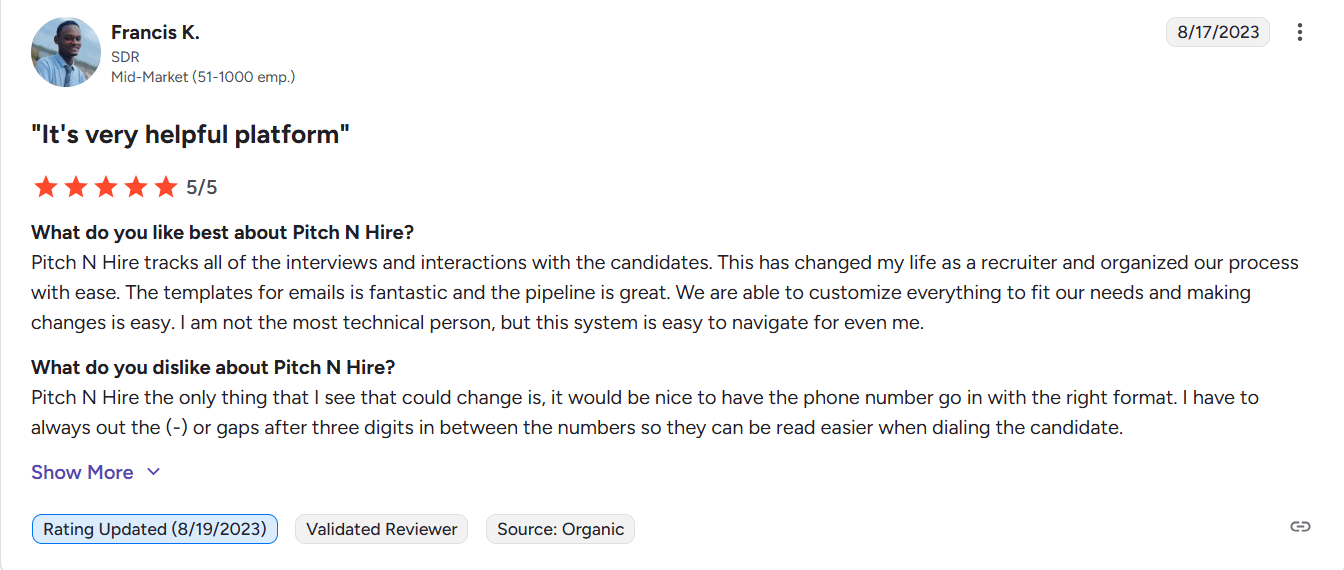
Francis K. – Sales Development Representative (Mid-Market)
“It tracks all interviews and interactions with candidates. Email templates are useful, and the pipeline is easy to navigate even for non-technical users.”
Source:
Read Pitch N Hire customer review on G2
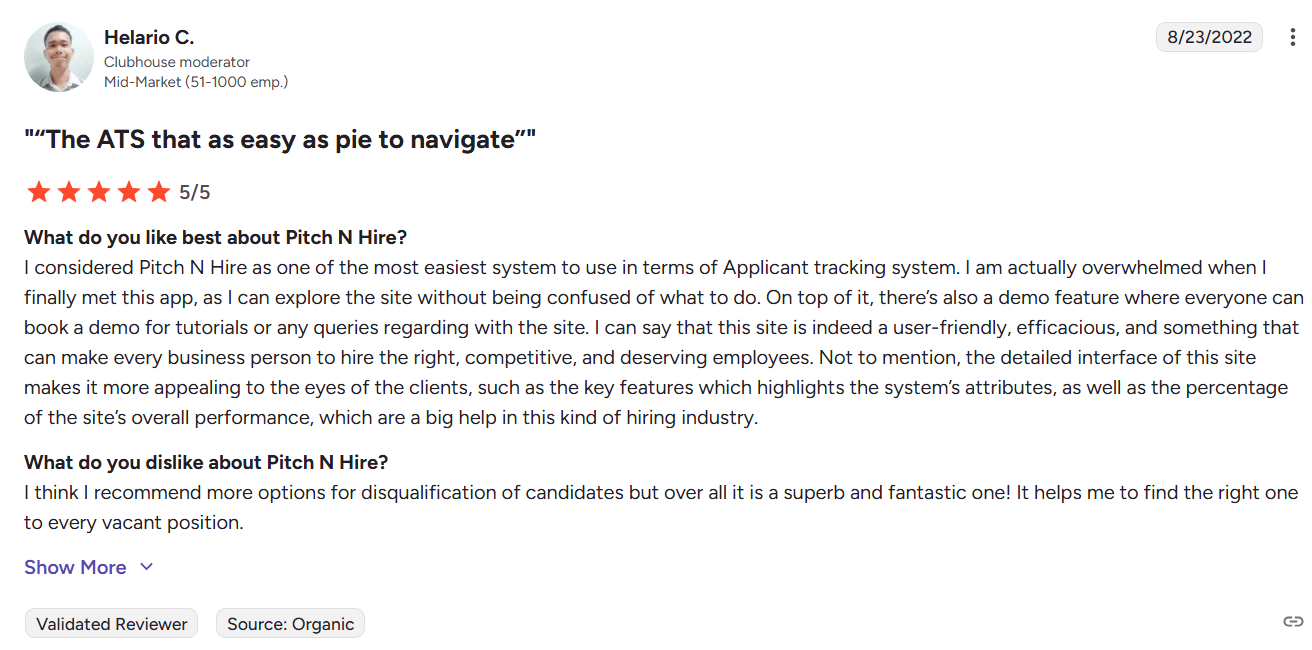
Helario C. – Clubhouse Moderator (Mid-Market)
“One of the easiest ATS systems to use. Intuitive and efficient.”
Source:
Read Pitch N Hire customer review on G2
Anant G. – Hiring Manager (Mid-Market)
“Excellent product with reasonable pricing that automates staffing workflows effectively.”
Source:
Read Pitch N Hire customer review on G2
Nikhil S. – Transcriptionist (Small Business)
“Perfect for job search and recruitment. The tagging and navigation features make the platform easy to use.”
Source:
Read Pitch N Hire customer review on G2

The applicant tracking system market size in 2026 reflects the critical role recruitment technology now plays in organizational success. Industry analysts estimate the global applicant tracking systems market has reached a valuation exceeding $3.2 billion USD, representing substantial growth from previous years. This expansion underscores how ATS software has transitioned from optional technology to essential infrastructure across organizations of all sizes.
Applicant tracking system market growth projections through 2030 paint an even more compelling picture. The ATS market is forecast to expand at a robust compound annual growth rate (CAGR) of 6.7% to 7.2% over the next four years, potentially reaching $4.3 billion to $4.5 billion by the end of the decade. This applicant tracking system market CAGR significantly outpaces general business software growth, highlighting recruitment technology as a high-priority investment area.
The recruitment software market forecast indicates that cloud-based ATS market growth will drive the majority of this expansion, as organizations increasingly favor flexible, scalable SaaS solutions over traditional on-premise deployments. The hiring software market is experiencing particular momentum in the mid-market segment, where companies are rapidly adopting sophisticated recruitment automation capabilities that were once accessible only to large enterprises.
These applicant tracking systems market forecast 2026 figures represent more than financial metrics—they signal a fundamental shift in how organizations approach talent acquisition. The ATS industry analysis reveals that companies view recruitment technology not as a cost center but as a strategic investment that directly impacts revenue growth, competitive positioning, and organizational agility.
Understanding how big is the applicant tracking systems market requires examining the economic and demographic forces driving adoption. Several interconnected factors are propelling the recruitment software market forward in 2026.
Global talent shortages have reached crisis levels across multiple sectors. The digital recruitment market analysis shows that 77% of organizations report difficulty filling open positions, with specialized technical roles, healthcare professionals, and skilled trades facing particularly acute shortages. This scarcity transforms recruitment from a periodic activity into a continuous imperative, making sophisticated talent acquisition software essential for maintaining competitive talent pipelines. Organizations can no longer rely on passive recruiting strategies—they need ATS platforms that proactively identify, engage, and nurture potential candidates long before positions open.
High employee turnover continues to challenge organizations across industries. The HR technology market data indicates that voluntary turnover rates have stabilized at elevated post-pandemic levels, with many sectors experiencing annual turnover exceeding 20%. This constant churn creates perpetual hiring demand, overwhelming recruitment teams that lack effective automated recruitment software. Applicant tracking systems that reduce time-to-hire and improve hiring quality directly impact retention by ensuring better person-role fit and more efficient backfilling of critical positions.
The rise of gig and contract hiring has fundamentally altered workforce composition. The talent acquisition market growth is increasingly driven by organizations building flexible workforce models that blend full-time employees with contractors, consultants, and project-based talent. Traditional recruitment approaches struggle with this complexity, while modern ATS for staffing agencies and enterprise applicant tracking systems seamlessly manage diverse worker types, different hiring workflows, and varied compliance requirements across employment categories.
Economic uncertainty and the need for organizational agility have made workforce planning more critical yet more challenging. Companies need recruitment technology that provides visibility into hiring pipelines, forecasts talent needs based on business projections, and enables rapid scaling up or down as conditions change. This strategic dimension elevates ATS from operational tool to business intelligence platform.
The competitive landscape for talent has intensified dramatically. Organizations compete not just locally but globally for remote-capable talent, meaning candidates have unprecedented choice. Companies with clunky, frustrating application processes lose top talent to competitors offering streamlined experiences. Best ATS for recruiters prioritizes candidate experience as a differentiator, recognizing that recruitment technology directly impacts employer brand and talent acquisition outcomes.

The applicant tracking software market exhibits significant variation across sectors, with certain industries leading adoption while others are rapidly catching up. Understanding these ATS software demand by industry patterns reveals where the recruitment software market is experiencing most rapid expansion.
IT & Technology companies have historically been early adopters of recruitment automation, and in 2026 they continue pushing the boundaries of what AI recruitment software market capabilities can deliver. Tech organizations face intense competition for software engineers, data scientists, and specialized technical talent, driving demand for AI-powered applicant tracking systems that can identify candidates with precise skill combinations. ATS for IT companies must handle high-volume technical screening, integrate with coding assessment platforms, and support employer branding initiatives that attract passive candidates. The technology sector's embrace of remote work has further increased reliance on cloud-based applicant tracking systems that manage globally distributed hiring processes.
Healthcare & Life Sciences represents one of the fastest-growing segments for ATS adoption. The combination of chronic nursing shortages, specialized medical roles requiring precise credential verification, and stringent compliance requirements makes ATS for healthcare recruitment essential rather than optional. Healthcare organizations need recruitment software that manages complex licensing verification, tracks continuing education requirements, handles high-volume seasonal hiring (particularly for travel nurses and temporary medical staff), and ensures HIPAA compliance in candidate data management. The applicant tracking systems market growth in healthcare is accelerating as hospital systems and healthcare networks consolidate, creating larger recruitment operations that demand enterprise-grade hiring software.
Banking, Financial Services & Insurance (BFSI) organizations are increasingly sophisticated ATS software users, driven by regulatory compliance needs and fierce competition for financial talent. ATS platforms serving BFSI must provide robust audit trails, support extensive background check integrations, manage complex approval workflows for sensitive positions, and ensure data security that meets financial services standards. The sector's shift toward digital banking and fintech innovation has created new talent categories—data scientists, cybersecurity specialists, user experience designers—requiring skill-based hiring software that identifies transferable capabilities from adjacent industries.
Manufacturing has emerged as a surprisingly dynamic segment of the recruitment technology market in 2026. As factories embrace Industry 4.0 technologies, they need workers with different skill profiles than traditional manufacturing roles required. ATS for manufacturing must handle both high-volume production worker recruitment and specialized technical hiring for roles like robotics technicians and process automation engineers. The challenge of manufacturing recruitment—combining physical location requirements with technical skill needs—has driven adoption of applicant tracking systems with sophisticated location-based filtering and mobile-optimized candidate experiences that reach blue-collar workers effectively.
Retail & E-commerce companies face unique hiring challenges that shape their ATS requirements. Seasonal hiring spikes, high turnover rates, geographically distributed locations, and large hourly workforce populations demand recruitment software optimized for volume and speed. Best applicant tracking systems 2026 for retail prioritize mobile application experiences (as retail candidates predominantly apply via smartphone), rapid screening and scheduling capabilities, integration with time and attendance systems, and location-based candidate matching. The e-commerce boom has intensified competition for warehouse workers and delivery personnel, making effective ATS platforms critical competitive differentiators.
Staffing & Recruitment Agencies represent the most intensive users of applicant tracking systems, as recruitment is their core business rather than a supporting function. ATS for staffing agencies and ATS for recruitment firms must support relationship-based recruiting, maintain extensive candidate databases spanning multiple clients and roles, manage complex client billing and candidate payroll workflows, and provide sophisticated reporting for client satisfaction. Agency recruiters often evaluate ATS software based on database search capabilities, client portal functionality, and efficiency features that maximize placements per recruiter. The recruitment software market growth in this segment is driven by agencies seeking competitive advantages through technology-enabled operational excellence.
The integration of artificial intelligence and machine learning represents the single most transformative driver of the applicant tracking systems market in 2026. AI-based applicant tracking systems have evolved from experimental features to core capabilities that fundamentally change how organizations identify and evaluate talent.
Resume parsing accuracy improvements powered by natural language processing have eliminated one of the most frustrating limitations of traditional ATS software. Early resume parsing software struggled with formatting variations, non-standard terminology, and creative resume designs, often missing qualified candidates whose resumes didn't conform to rigid templates. Modern AI resume screening software understands semantic meaning, recognizes skills regardless of vocabulary variations, extracts relevant information from diverse document formats including PDFs, Word documents, and even scanned images, and identifies transferable skills that may not be explicitly stated but are implied by experience patterns.
AI-based candidate ranking moves far beyond simple keyword matching to provide intelligent prioritization that reflects genuine candidate-role fit. Machine learning ATS algorithms analyze hundreds of data points—skills, experience levels, career progression patterns, education credentials, certifications, industry background, and geographic factors—to generate multidimensional fit scores. These systems learn from historical hiring outcomes, identifying which candidate characteristics correlate with successful hires in specific roles and refining their recommendations over time. This capability transforms recruiter productivity, allowing talent acquisition teams to focus their attention on the most promising candidates rather than manually reviewing every application.
Predictive hiring analytics represent perhaps the most strategically valuable AI recruitment software capability. Advanced ATS platforms now forecast candidate success probability based on historical performance data, predict which candidates are most likely to accept offers (reducing wasted effort on unlikely prospects), estimate time-to-hire for specific role types based on market conditions, identify bottlenecks in hiring processes before they cause delays, and recommend optimal interview panel compositions based on past evaluation accuracy. This predictive hiring analytics functionality elevates applicant tracking systems from operational tools to strategic business intelligence platforms that inform workforce planning and talent strategy.
The AI recruitment software market growth reflects recognition that these capabilities deliver tangible business value—reduced time-to-hire, improved quality of hire, enhanced diversity outcomes, and significant recruiter productivity gains. Organizations implementing AI-powered applicant tracking systems report screening time reductions of 60-75%, time-to-hire improvements of 30-40%, and measurable increases in new hire performance and retention.

The permanent shift toward distributed work arrangements has fundamentally altered talent acquisition, creating both challenges and opportunities that drive recruitment software market growth.
Managing distributed talent pipelines requires ATS software capabilities that didn't exist in pre-pandemic recruitment technology. Organizations now compete in a global talent marketplace, sourcing candidates without geographic constraints while managing substantially larger applicant pools. Cloud-based applicant tracking systems enable distributed hiring teams to collaborate effectively across locations and time zones, provide candidates with consistent experiences regardless of where they're applying from, support asynchronous interview processes that accommodate different schedules, and maintain centralized visibility into hiring activities across multiple regions.
Cross-border compliance challenges have become significantly more complex as remote work enables companies to hire internationally. Best ATS software 2026 includes built-in compliance frameworks that navigate varying employment laws across jurisdictions, manage work authorization and visa requirements, track right-to-work documentation, ensure data privacy compliance with regulations like GDPR in Europe and similar frameworks in other regions, and adapt offer letters and employment contracts to local legal requirements. The global recruitment software market is expanding rapidly as mid-sized companies, which previously hired only locally, now access international talent and need applicant tracking systems with global capabilities.
The hybrid work model has created new evaluation criteria for candidates. Organizations need to assess not just skills and experience but also remote work capabilities, collaboration styles suited to distributed teams, and self-management competencies. Next-generation ATS platforms incorporate assessment integrations and structured evaluation frameworks that help hiring teams consistently evaluate these less tangible attributes.
This geographic expansion of talent acquisition has made scalable ATS platforms essential. Companies that once managed dozens of applications per open role now receive hundreds or even thousands as they open positions to nationwide or global candidate pools. Only sophisticated recruitment automation can handle this volume while maintaining candidate experience quality and hiring speed.
The business impact of slow hiring has never been more acute, creating intense pressure for recruitment technology that accelerates talent acquisition processes.
Impact of slow hiring on revenue is direct and measurable. For revenue-generating roles, every day a sales position remains vacant represents lost opportunities and revenue. For critical technical positions, delayed hiring slows product development, postpones feature launches, and enables competitors to gain market advantages. For customer-facing roles, understaffing degrades service quality and customer satisfaction. Organizations have quantified these costs, determining that for many positions, the daily cost of vacancy exceeds several hundred to several thousand dollars—making investments in automated recruitment software that reduces time-to-hire highly ROI-positive.
Automation as a competitive advantage has transformed from a nice-to-have efficiency gain to a strategic imperative. The best applicant tracking systems 2026 automate every automatable step: job posting distribution, resume screening, candidate communications, interview scheduling, feedback collection, and status updates. This recruitment automation eliminates bottlenecks that traditionally extended hiring cycles—waiting for recruiter resume reviews, email tag for scheduling interviews, delayed feedback from hiring managers, and administrative task completion.
Top talent remains available on the market for extremely short windows—often just 10 days or less for in-demand specialists. Companies with slow hiring processes consistently lose preferred candidates to faster-moving competitors. ATS software that shortens each process stage, even by just a day or two per step, can transform hiring outcomes. Organizations report that reducing time-to-hire from 45 days to 30 days through recruitment software implementation can improve offer acceptance rates by 15-25%, as candidates remain engaged and haven't received competing offers.
The hiring software market growth is substantially driven by this time-to-hire imperative. Companies recognize that their applicant tracking system directly impacts their ability to hire top talent before competitors do, making ATS investment a competitive necessity rather than an operational convenience.
The regulatory environment surrounding employment and data privacy has grown increasingly complex, making compliance-capable recruitment software essential for risk management.
GDPR (General Data Protection Regulation) has established rigorous standards for how candidate data must be collected, stored, processed, and ultimately deleted. The Europe applicant tracking systems market is particularly focused on GDPR compliance, but the regulation's extraterritorial scope means any organization hiring in Europe must comply. Best ATS for recruiters operating internationally includes GDPR-compliant features: explicit consent mechanisms for data collection, candidate data access and portability tools, automated data retention and deletion workflows, audit trails documenting data access and usage, and data processing agreements with third parties.
EEOC (Equal Employment Opportunity Commission) compliance in the United States requires careful documentation of hiring processes and demographic data collection that demonstrates non-discriminatory practices. Modern applicant tracking systems facilitate this compliance by standardizing interview questions and evaluation criteria, tracking applicant flow data by demographic categories, generating reports demonstrating diverse candidate pools, and maintaining documentation that can defend against discrimination claims. The shift toward bias-free recruitment technology is driven partly by legal compliance requirements and partly by organizational diversity, equity, and inclusion (DEI) commitments.
ISO and SOC certifications have become differentiators in the ATS market 2026, particularly for enterprise applicant tracking systems serving regulated industries. Organizations need confidence that their recruitment software meets rigorous security and data protection standards. Top ATS software 2026 providers undergo regular audits and maintain certifications that verify their security practices, data handling procedures, disaster recovery capabilities, and operational controls meet industry standards.
Additional compliance considerations vary by industry and geography: healthcare organizations need HIPAA-compliant ATS software, financial services require systems meeting banking regulations, federal contractors must comply with OFCCP requirements, and various states and municipalities have enacted salary history ban laws, criminal history inquiry restrictions, and other regulations that applicant tracking software must accommodate.
This regulatory complexity drives ATS adoption trends as organizations recognize that manual compliance management is untenable. Compliance-ready ATS platforms build regulatory requirements into their workflows, ensuring adherence happens automatically rather than depending on recruiter knowledge and vigilance.

The applicant tracking software market exhibits clear segmentation by deployment approach, reflecting diverse organizational needs, technical capabilities, and strategic priorities.
Cloud-based ATS solutions dominate the market in 2026, representing approximately 75-80% of new implementations. The cloud-based applicant tracking system model offers compelling advantages that align with contemporary business priorities: minimal upfront capital investment with subscription-based pricing, rapid implementation timelines (often 4-6 weeks versus 6-12 months for on-premise systems), automatic updates and feature additions without IT involvement, inherent scalability to accommodate hiring volume fluctuations, accessibility from any location supporting remote recruitment teams, and reduced IT burden as the vendor manages infrastructure, security, and maintenance.
Cloud-based ATS market growth is accelerating as even traditionally conservative organizations embrace SaaS models. The maturation of cloud security, increased comfort with data residing outside corporate firewalls, and demonstrated reliability of major cloud infrastructure providers have overcome previous hesitations. Best ATS software 2026 offerings leverage cloud capabilities to deliver features impossible in traditional architectures: real-time collaboration, continuous machine learning model improvement, seamless integrations with other cloud HR systems, and mobile-first experiences.
The shift toward cloud-based recruitment software is particularly pronounced among small and mid-sized organizations that lack extensive IT resources. For these companies, the affordable ATS software provided through cloud subscriptions delivers enterprise-grade capabilities without requiring dedicated technical staff or significant capital investments.
On-premise ATS software retains relevance for specific use cases despite the broader cloud trend. Certain organizations continue preferring on-premise deployment for several reasons: highly regulated industries with data sovereignty requirements, organizations with existing substantial IT infrastructure investments and internal management capabilities, companies operating in regions with unreliable internet connectivity, and enterprises with unique customization requirements not easily accommodated in multi-tenant cloud architectures.
The enterprise applicant tracking systems segment includes both deployment models, with large organizations often implementing hybrid approaches—cloud ATS for general recruitment with on-premise components for highly sensitive hiring (executive search, security-cleared positions). The on-premise ATS market is projected to decline slowly rather than disappear, stabilizing at approximately 20-25% of new deployments, primarily serving niche requirements that cloud solutions cannot adequately address.
ATS software pricing models differ significantly between deployment approaches, with cloud solutions favoring per-user-per-month or per-hire pricing while on-premise systems typically involve perpetual licenses with annual maintenance fees. This pricing structure makes cloud-based applicant tracking systems more accessible to organizations with variable hiring needs and limited upfront budgets.
The ATS market exhibits distinct segmentation by company size, with each segment presenting unique requirements, purchasing behaviors, and growth trajectories.
Small businesses & startups represent the fastest-growing segment for ATS adoption in 2026. Historically, small organizations relied on manual recruitment processes or basic email-based workflows, viewing applicant tracking systems as enterprise tools beyond their needs and budgets. This perception has shifted dramatically as ATS for small businesses and ATS for startups has emerged offering: affordable entry-level pricing (often $100-500 monthly), simplified implementation requiring minimal setup, intuitive interfaces requiring little training, essential features without overwhelming complexity, and mobile optimization reflecting how small business owners work.
The recruitment software market growth in this segment is driven by several factors: increasing difficulty attracting talent in competitive markets, recognition that professional recruitment processes improve employer brand, availability of affordable cloud-based solutions removing budget barriers, and startup growth requiring structured hiring as companies scale from 10 to 50 to 100+ employees. Small organizations prioritize ATS ease of use and quick value realization over comprehensive feature sets, favoring solutions they can implement and benefit from within days.
Mid-market companies (typically 100-1,000 employees) represent the sweet spot for many ATS software providers. ATS for mid-sized companies must balance sophistication with usability, offering advanced capabilities like: customizable hiring workflows, comprehensive reporting and analytics, integration with existing HR systems (HRIS, payroll), multi-location and department management, career site and employer branding tools, and assessment and interview scheduling integrations.
This segment demonstrates strong applicant tracking system market growth as mid-market organizations professionalize their talent acquisition functions, adding dedicated recruiters and building more sophisticated hiring processes. These companies have outgrown basic recruitment software but may not require (or afford) the full complexity of enterprise applicant tracking systems. Best ATS for recruiters serving mid-market clients emphasizes configuration flexibility allowing companies to start simply and add sophistication as needs evolve.
Large enterprises (1,000+ employees) require enterprise applicant tracking systems with capabilities that smaller organizations don't need: support for thousands of concurrent users, global deployment across multiple countries and languages, complex approval workflows reflecting organizational hierarchies, extensive customization and configuration options, sophisticated security including single sign-on and role-based access, high-volume processing capabilities, comprehensive API access for custom integrations, and dedicated account management and support.
The large enterprise ATS market is characterized by longer sales cycles, more extensive evaluation processes, and higher implementation complexity. These organizations often issue formal RFPs, conduct proof-of-concept implementations, and involve multiple stakeholders in selection decisions. Top ATS software 2026 for enterprises must demonstrate scalability, reliability, security, and long-term viability.
Pricing varies dramatically across segments: affordable ATS software for small businesses might cost $100-500 monthly, mid-market solutions typically range $5,000-25,000 annually, while enterprise implementations can exceed $100,000-500,000 annually depending on user count, customization, and included services.
The applicant tracking systems market also segments by the type of organization implementing the technology, reflecting distinct use cases and feature requirements.
Corporate HR teams represent the largest end-user segment. These internal recruitment functions serve their employer organization exclusively, hiring across all roles from entry-level to executive. Best ATS for recruiters serving corporate HR emphasizes: integration with internal HR systems (HRIS, payroll, onboarding), employee referral program management, internal mobility and redeployment tools, employer branding and career site capabilities, hiring manager collaboration features, and compliance reporting for EEOC and other regulations.
Corporate HR teams typically prioritize ATS software that improves hiring quality and candidate experience while reducing time-to-fill. They seek recruitment automation that allows small teams to manage high volumes without sacrificing candidate personalization.
Staffing firms and recruitment agencies use ATS quite differently than corporate HR. ATS for staffing agencies and ATS for recruitment firms must support: relationship-based recruiting with extensive candidate relationship management, multi-client management with separate workflows and branding, candidate placement tracking across multiple client companies, billing and payroll integration, client portal access, and database-centric workflows maximizing candidate-to-role matching across all available opportunities.
Staffing and agency recruiters are power users who spend entire workdays in their ATS, making interface efficiency, database search capabilities, and productivity features critical. The recruitment software market serving this segment emphasizes speed and database functionality over candidate experience features, though modern top ATS software 2026 recognizes that agencies also compete on candidate experience.
RPO (Recruitment Process Outsourcing) providers require hybrid capabilities combining elements of both corporate HR and staffing agency ATS needs. RPO ATS platforms must support multi-client environments while providing white-labeled candidate experiences, blend relationship-based recruiting with process-driven workflows, offer extensive reporting for client satisfaction measurement, and scale dramatically as RPO contracts fluctuate.
The talent acquisition software market serving RPO providers represents a sophisticated niche with specialized requirements reflecting the complexity of managing recruitment operations on behalf of multiple client organizations simultaneously.

North America maintains its position as the largest and most mature regional applicant tracking systems market, accounting for approximately 45-50% of global ATS software revenue in 2026. The North America ATS market leadership reflects several reinforcing factors: early technology adoption across industries, highly competitive talent markets driving investment in recruitment technology, mature HR technology ecosystems with established integration partnerships, strong venture capital and private equity investment in HR tech innovation, and regulatory environment encouraging technology-enabled compliance.
AI-first recruitment adoption is particularly advanced in North America, with organizations rapidly implementing AI-powered applicant tracking systems and AI recruitment software capabilities. Major technology hubs—Silicon Valley, Seattle, Austin, Boston, New York—lead in sophisticated recruitment technology utilization, setting standards that spread across industries and geographies. The region's concentration of HR tech vendors creates a competitive environment driving rapid innovation.
The United States dominates the regional market, with ATS adoption reaching high penetration in enterprises and mid-market companies while accelerating among small businesses. Canada represents a smaller but growing market with particular interest in bias-free recruitment technology and multilingual capabilities (English/French). The recruitment automation market in North America is expected to maintain steady growth through 2030, driven by ongoing labor shortages, increasing recruitment complexity, and continuous technological advancement.
Pricing expectations in North America tend toward the premium end of the market, with organizations willing to invest in best applicant tracking systems 2026 that deliver measurable ROI through improved hiring outcomes. The market exhibits strong interest in comprehensive platforms versus point solutions, favoring ATS software that integrates multiple recruitment capabilities.

The Europe applicant tracking systems market exhibits distinctive characteristics shaped by the region's regulatory environment, cultural diversity, and employment practices. European ATS market growth is projected at 7-9% CAGR through 2030, slightly exceeding global averages as the region catches up with North American adoption levels.
GDPR-centric ATS demand defines the European market more than any other factor. The General Data Protection Regulation has created stringent requirements for how candidate data must be handled, making GDPR compliance a mandatory feature rather than optional capability. Best ATS software 2026 for European deployment must demonstrate: explicit consent mechanisms, candidate data access rights, right-to-erasure functionality, data portability, cross-border data transfer protections, and comprehensive audit trails. Many global ATS vendors developed their GDPR capabilities specifically for European requirements, subsequently offering these features worldwide.
Ethical and bias-free hiring receives particularly strong emphasis in European markets. Organizations seek bias-free recruitment technology with features like blind resume screening, structured interview frameworks, diversity analytics, and explainable AI that can articulate decision rationale. The Europe focus on workplace equity and social responsibility drives demand for ATS capabilities that demonstrably improve diversity outcomes and reduce unconscious bias in hiring processes.
The European market exhibits significant variation across countries: United Kingdom maintains mature ATS adoption comparable to North America despite Brexit complexities, Germany demonstrates strong demand particularly in manufacturing and engineering, France requires solutions accommodating strict labor laws and works council involvement, Nordic countries lead in innovative recruitment practices and technology adoption, and Southern and Eastern Europe represent high-growth markets with rapidly increasing ATS implementation.
Language and cultural requirements add complexity to European ATS deployment. Multi-language support isn't optional—organizations need applicant tracking systems that seamlessly handle recruitment in multiple languages across different countries. The region's diverse employment practices, from apprenticeship systems to works council requirements, demand flexible recruitment software that adapts to local norms while maintaining consistent global processes.
The Asia-Pacific ATS market represents the highest-growth regional segment, projected to expand at 9-12% CAGR through 2030—substantially exceeding global averages. This fastest-growing ATS region status reflects multiple powerful drivers: rapid digital transformation across industries, explosive growth in technology and business process outsourcing sectors with intensive hiring needs, increasing sophistication of HR practices in emerging economies, massive labor markets requiring scalable recruitment solutions, and substantial venture capital investment in HR technology startups.
Startup ecosystem influence is particularly pronounced in the Asia-Pacific region. Cities like Bangalore, Singapore, Beijing, Shanghai, Sydney, Seoul, and Tokyo host vibrant technology startup communities creating both demand for sophisticated recruitment software and innovation in recruitment technology itself. Many emerging ATS vendors serving global markets originate in Asia-Pacific, bringing fresh perspectives and innovative approaches to talent acquisition challenges.
The Asia-Pacific ATS market exhibits extreme diversity across countries: India represents massive growth potential with expanding IT services, business process outsourcing, and domestic technology sectors China demonstrates increasing adoption as organizations modernize HR practices, though unique regulatory requirements and technology ecosystems create distinct market dynamics, Japan shows growing interest in recruitment automation as demographic challenges and labor shortages intensify, Australia maintains mature ATS adoption comparable to Western markets with strong emphasis on compliance and candidate experience, Southeast Asian countries (Singapore, Malaysia, Indonesia, Vietnam, Philippines) represent high-growth markets as economies develop and organizations professionalize recruitment.
Mobile-first design is particularly critical in Asia-Pacific markets where smartphone penetration often exceeds desktop access. Best applicant tracking systems 2026 for the region prioritize mobile-optimized candidate experiences, recognizing that many candidates will discover, research, and apply for positions entirely through mobile devices.
The talent acquisition software market in Asia-Pacific is characterized by price sensitivity, with many organizations seeking affordable ATS software that delivers core capabilities without premium pricing. This creates opportunities for regional vendors offering localized solutions and established global vendors providing right-sized packages for emerging markets.

The Middle East & Africa ATS market represents an emerging segment with substantial growth potential, though from a smaller base than other regions. This market is projected to grow at 8-10% CAGR through 2030, driven by economic development, digital transformation initiatives, and modernizing HR practices.
Emerging digital recruitment infrastructure is rapidly developing across the region. Major cities—Dubai, Abu Dhabi, Riyadh, Cairo, Lagos, Nairobi, Johannesburg, and Cape Town—are establishing themselves as business and technology hubs where ATS adoption is accelerating. The region's young, tech-savvy population is driving demand for modern recruitment experiences, pressuring organizations to implement contemporary recruitment software.
Government-led digitization initiatives are significant market drivers, particularly in Gulf Cooperation Council (GCC) countries. Governments are investing heavily in digital infrastructure, creating smart cities, and promoting technology adoption across sectors. These initiatives extend to employment and talent acquisition, with government entities themselves implementing applicant tracking systems and encouraging private sector adoption through various incentive programs.
The Middle East & Africa market presents unique considerations: workforce demographics with substantial expatriate populations require ATS software managing complex nationality and work authorization requirements, multilingual requirements (Arabic, English, French, various local languages) are essential, varying levels of technology infrastructure require robust solutions that perform reliably even with inconsistent connectivity, cultural considerations around hiring practices necessitate flexible ATS platforms that accommodate local customs, and emerging regulatory frameworks as countries develop modern employment laws and data protection requirements.
Oil and gas, construction, hospitality, healthcare, and financial services represent key industries driving ATS demand in the region. Large infrastructure projects create episodic high-volume hiring needs requiring scalable recruitment software. The region's role as a global business hub, particularly in the UAE, creates demand for sophisticated enterprise applicant tracking systems comparable to those used in North America and Europe.
Price sensitivity varies substantially across the region, with GCC countries demonstrating willingness to invest in premium recruitment technology while Sub-Saharan African markets often seek more affordable ATS software solutions. Successful vendors in this market offer flexible deployment models and pricing structures accommodating diverse economic conditions.
The future of applicant tracking systems is inextricably linked to artificial intelligence, with AI-driven decision-making transforming recruitment from an art relying on recruiter intuition to a science supported by data and predictive models.
Skill-based hiring represents perhaps the most significant shift in talent evaluation philosophy enabled by AI recruitment software. Traditional credential-based screening—prioritizing degrees from specific schools, years of experience in identical roles, specific job titles—systematically excludes qualified candidates whose paths differed from conventional trajectories. Skill-based hiring software analyzes candidates based on demonstrable competencies rather than proxies like credentials, identifies transferable skills from adjacent industries or different roles, recognizes that capabilities can be developed through diverse experiences including self-directed learning, military service, volunteer work, and personal projects, and evaluates candidates against role requirements defined as specific skills and competencies rather than experience templates.
This approach dramatically expands talent pools, improves diversity outcomes by reducing bias embedded in credential-based screening, and enables organizations to find candidates that traditional methods would overlook. AI-powered applicant tracking systems excel at skill identification because they can parse and understand skills expressed in various ways across resumes, work samples, assessments, and interviews, then match them against detailed skill requirements for each role.
Predictive success scoring elevates recruitment from matching current qualifications to forecasting future performance. Advanced machine learning ATS algorithms analyze historical hiring data to identify patterns correlating with successful hires: which combinations of skills predict high performance in specific roles, which experience patterns indicate strong learning agility and growth potential, which behavioral attributes correlate with retention and cultural fit, and which candidate sources consistently produce successful hires. These insights transform into predictive models that score new candidates on their likelihood of succeeding in the role and staying with the organization.
This predictive hiring analytics capability changes how recruiters work. Rather than manually reviewing every resume and guessing which candidates might succeed, recruiters receive intelligent recommendations highlighting candidates most likely to excel. This allows talent acquisition teams to focus their time on high-probability candidates, improving both efficiency and hiring outcomes.
The AI-based applicant tracking system trend extends beyond candidate evaluation to process optimization. AI analyzes recruitment workflows to identify bottlenecks, recommends process improvements based on data patterns, predicts how long each stage will take for specific role types, and even suggests optimal interview panel compositions based on historical evaluation accuracy. This holistic application of artificial intelligence transforms the ATS from a tracking tool to an intelligent hiring advisor.
As organizations commit more deeply to diversity, equity, and inclusion, demand grows for bias-free recruitment technology that helps translate DEI commitments into measurable hiring outcomes.
DEI-focused ATS features are moving from nice-to-have additions to core capabilities. Best ATS software 2026 includes: blind screening options that remove identifying information (names, graduation dates, location) that might trigger unconscious bias, structured interview frameworks ensuring all candidates answer identical questions with standardized evaluation criteria, diverse candidate sourcing tools that expand recruitment beyond traditional networks, bias alerts that notify recruiters when language in job descriptions or evaluation criteria might discourage diverse applicants, diversity analytics providing visibility into candidate pipeline demographics at every hiring stage, and inclusive language checking that identifies potentially exclusionary terminology in job postings and communications.
Explainable AI addresses a critical tension in AI recruitment software—while machine learning can improve hiring decisions, opaque "black box" algorithms raise concerns about hidden biases and lack of accountability. Explainable AI in applicant tracking systems provides transparency about how decisions are made: which factors influenced a candidate's score, why one candidate ranked higher than another, what patterns the algorithm identified as success indicators, and how recruiters can challenge or override AI recommendations when human judgment suggests different conclusions.
This transparency is essential for legal compliance (particularly under evolving AI regulation), organizational accountability to DEI commitments, and recruiter trust in AI-assisted decision-making. Organizations implementing AI-powered applicant tracking systems increasingly demand explainability features that allow them to audit algorithmic decision-making for potential bias.
The bias-free recruitment technology trend also encompasses proactive bias detection. Advanced ATS platforms analyze hiring outcomes to identify patterns suggesting bias: whether certain demographic groups disproportionately exit the hiring process at specific stages, whether evaluation scores vary systematically across demographics for candidates with similar qualifications, whether job requirements inadvertently exclude diverse candidates without business justification, and whether specific recruiters or hiring managers exhibit evaluation patterns suggesting unconscious bias.
These insights enable organizations to address bias systemically rather than case-by-case, improving diversity outcomes at scale. The recruitment software market increasingly recognizes that DEI isn't just an ethical imperative but a business advantage—diverse teams demonstrate better decision-making, innovation, and financial performance.
The drive toward comprehensive recruitment automation reflects organizational demands for efficiency, consistency, and the ability to manage increasing hiring volumes without proportional staff expansion.
Automated workflows eliminate the repetitive manual tasks that consume recruiter time. Modern automated recruitment software handles: job posting distribution across multiple channels with a single click, candidate communication including application confirmations, status updates, and rejection notices, resume screening and initial qualification assessment, interview scheduling with automatic calendar coordination, feedback reminder prompts to hiring managers, reference check initiation and tracking, offer letter generation with appropriate compensation and terms, and background check orders and results tracking.
This automation doesn't just save time—it improves candidate experience by ensuring prompt, consistent communication and accelerating the hiring process. The hiring software market growth is substantially driven by organizations recognizing that automation directly impacts their ability to compete for talent by moving faster than competitors.
Zero-touch screening represents the frontier of recruitment automation, where initial candidate evaluation happens entirely without human intervention. AI resume screening software combined with structured qualification frameworks can screen hundreds or thousands of applications, identify candidates meeting minimum requirements, rank them by fit score, and automatically advance top candidates to the next stage—all without recruiter involvement until genuinely qualified candidates require human evaluation. This capability is particularly valuable for high-volume hiring scenarios like hourly workforce recruitment, campus hiring programs, and seasonal staff acquisition.
The automation philosophy underlying best applicant tracking systems 2026 is "automate the automatable, humanize the personal." Repetitive tasks, data entry, scheduling coordination, and status tracking should be automated completely. Personal interactions—phone screens, interviews, offer conversations, relationship building—should receive full human attention, enhanced by AI insights but driven by recruiter expertise and interpersonal skills.
Scalable ATS platforms enable organizations to handle hiring volume fluctuations without corresponding team size changes. Companies can scale from 50 hires monthly to 500 during growth periods using the same recruitment team because automation absorbs the increased volume. This scalability is particularly valuable for organizations experiencing rapid growth, seasonal hiring patterns, or unpredictable hiring needs.
The recognition that candidate experience directly impacts hiring outcomes and employer brand has elevated it from a soft concern to a strategic priority, influencing ATS software design and feature priorities.
Mobile-first ATS design reflects the reality that many candidates—particularly younger workers and hourly employees—conduct job searches primarily or exclusively on smartphones. Best applicant tracking systems 2026 provide: mobile-optimized career sites that load quickly and display perfectly on small screens, streamlined application processes requiring minimal typing and supporting document uploads from phone cameras, one-click apply functionality integrating with LinkedIn and other professional profiles, SMS-based communication options as many candidates prefer text to email, and mobile-friendly interview scheduling allowing candidates to select times and receive confirmations via phone.
Organizations implementing mobile-first recruitment software report significant increases in application completion rates, particularly for roles where candidates skew toward mobile usage. The applicant tracking software market increasingly recognizes mobile optimization as mandatory rather than optional.
Simplified application journeys eliminate the lengthy, frustrating application processes that characterize many organizations' hiring. Traditional applications might require 20-30 minutes of form completion, asking redundant information already present in resumes, and demanding data irrelevant to initial screening. Modern ATS platforms streamline applications to essential information only, auto-populate fields from uploaded resumes or LinkedIn profiles, save partially completed applications allowing candidates to return later, and delay detailed information collection until candidates advance further in the process when investment of time is justified.
The impact is substantial: simplifying applications from 30 minutes to 5-7 minutes can increase application completion by 50-70%. Since top candidates rarely tolerate frustrating application experiences, simplified processes directly improve candidate quality.
Transparency and communication define positive candidate experiences. Best ATS for recruiters enables: clear timeline expectations about how long the process will take, regular status updates so candidates know where they stand, insight into next steps and what to expect, feedback on why they were rejected (where feasible), and easy access to recruiter contact for questions. This transparency builds employer brand even among candidates who aren't hired—many will apply again in the future or recommend the company to others.
The talent acquisition software market recognizes that candidate experience and recruiter experience are interlinked. ATS software that makes recruiters more efficient through automation and workflow support enables them to provide better candidate experiences because they have time for personalized communication rather than being overwhelmed by administrative tasks.
The evolution from standalone applicant tracking systems to integrated HR technology ecosystems represents a fundamental shift in how organizations approach recruitment technology strategy.
HRMS (Human Resource Management System) integration creates seamless transitions from candidate to employee. When ATS and HRMS connect: new hire data transfers automatically from the ATS to the HRMS without manual re-entry, onboarding workflows initiate immediately upon offer acceptance, employee records maintain complete employment history from initial application, and workforce planning leverages both current employee data and hiring pipeline visibility. This integration eliminates data silos, reduces administrative burden, and improves new hire experience.
Payroll integration becomes relevant for organizations handling contract workers, temporary staff, or payment for assessment completion or relocation expenses during recruitment. ATS platforms that connect with payroll systems streamline these financial workflows without requiring separate data entry.
CRM (Candidate Relationship Management) capabilities or integrations enable relationship-based recruiting beyond immediate openings. Organizations build talent pools of potential candidates for future needs, nurture relationships through personalized content and outreach, track candidate interactions over extended timeframes, and convert passive candidates to applicants when appropriate opportunities arise. This strategic approach to talent acquisition requires ATS software with robust relationship management features or integrations with dedicated CRM platforms.
Job board integrations remain fundamental despite evolving sourcing strategies. Best applicant tracking systems 2026 connect with dozens or hundreds of job boards, enabling: one-click posting to multiple boards simultaneously, automatic posting renewal when positions remain open, application routing back to the ATS regardless of source, and performance analytics showing which boards generate the best candidates. These integrations save significant time while ensuring maximum job visibility.
Beyond these core integrations, modern ATS platforms connect with expanding ecosystems: assessment providers for skills testing and personality evaluations, video interviewing platforms for asynchronous and live interview capabilities, background check services for automated screening order and results retrieval, reference checking tools for structured reference collection, e-signature services for offer letter and document execution, calendar systems (Outlook, Google Calendar) for interview scheduling, communication platforms (Slack, Teams) for hiring team collaboration, analytics and business intelligence tools for advanced reporting, and marketing automation platforms for recruitment marketing campaigns.
The recruitment software market increasingly evaluates ATS not as standalone tools but as integration hubs connecting diverse recruitment technologies into cohesive ecosystems. Top ATS software 2026 offerings emphasize open APIs, pre-built integrations with popular tools, and partnership ecosystems ensuring compatibility with emerging HR technology solutions.

As applicant tracking systems collect and store sensitive personal information about thousands of job seekers, data protection and security become paramount concerns influencing ATS selection and implementation.
Candidate data protection extends beyond compliance to ethical obligations. ATS platforms house names, contact information, employment histories, education records, assessment results, sometimes demographic data for EEOC reporting, and occasionally sensitive information like salary history or background check results. Breaches exposing this data create significant harm to candidates whose personal information becomes vulnerable to identity theft, discrimination, or reputational damage.
The recruitment software market has witnessed increasing cyber-attacks targeting HR systems as threat actors recognize the value of personal data. ATS vendors must implement: robust encryption for data at rest and in transit, regular security audits and penetration testing, multi-factor authentication for user access, role-based access controls limiting who can view sensitive data, comprehensive audit trails tracking data access and modifications, and incident response plans for breach scenarios.
Breach prevention requires both technology safeguards and organizational practices. Best ATS software 2026 incorporates security by design, but organizations must also: train recruiters on data security best practices, limit data collection to what's genuinely necessary for evaluation, establish data retention policies ensuring information is deleted when no longer needed, vet third-party integrations for security standards, and maintain vendor oversight ensuring ATS providers maintain robust security postures.
The regulatory environment around data protection continues evolving. Beyond GDPR in Europe, various US states have enacted privacy laws (California Consumer Privacy Act, Virginia Consumer Data Protection Act), and other countries are implementing similar frameworks. ATS platforms operating globally must navigate this complex regulatory landscape while providing organizations with tools ensuring compliance across jurisdictions.
Candidate trust represents a business consideration beyond legal compliance. Organizations known for strong data protection practices enhance their employer brand, while those experiencing breaches or demonstrating casual attitudes toward candidate data suffer reputational damage affecting their ability to attract talent. The applicant tracking systems market increasingly prioritizes security as a differentiator, with organizations willing to pay premium prices for ATS vendors demonstrating exceptional data protection capabilities.
While recruitment automation delivers substantial benefits, excessive or poorly implemented automation can harm hiring outcomes, creating a challenge ATS vendors and users must navigate carefully.
The human vs AI balance remains nuanced. Over-reliance on automated screening can: eliminate qualified candidates whose backgrounds don't match rigid algorithms, miss candidates with non-traditional paths who might bring valuable diverse perspectives, create frustrating candidate experiences when automation goes wrong (incorrect rejections, communication errors), reduce recruiter skill development as professionals lose opportunity to exercise judgment, and damage employer brand when candidates perceive hiring processes as impersonal or algorithmic.
Candidate drop-off during application processes often results from excessive automation or poor implementation. Common issues include: applications requiring too much information upfront before candidates understand enough about the opportunity to invest significant time, resume parsing errors creating frustration when systems misinterpret information, lack of human interaction during extended processes causing candidates to feel undervalued, automated rejection communications that are abrupt or impersonal, and technical problems with ATS interfaces causing application abandonment.
Research indicates that application abandonment rates can exceed 60-70% for poorly designed processes, meaning organizations lose the majority of potential candidates before ever evaluating them. Best applicant tracking systems 2026 address this through streamlined application design, robust technical performance, balanced automation preserving appropriate human touch-points, and candidate-friendly communication maintaining engagement throughout the process.
The solution isn't eliminating automation but implementing it thoughtfully. Recruitment automation should handle tasks where it adds clear value—scheduling coordination, status updates, data processing—while preserving human interaction for activities where personal connection matters—phone screens, interviews, offer conversations. Top ATS software 2026 provides flexibility allowing organizations to configure the automation level appropriate for their culture, talent market, and candidate expectations.
Some roles and candidate populations require more high-touch recruiting approaches regardless of technology capabilities. Executive search, specialized technical roles, and candidates being recruited from competitor organizations often expect personalized attention that pure automation cannot provide. ATS platforms must support both high-automation and high-touch approaches, allowing recruiters to adjust strategies based on context.
Despite clear value propositions, organizations often struggle with ATS implementation and adoption, creating friction that limits return on investment and sometimes leads to project failure.
Change management represents perhaps the most underestimated implementation challenge. Moving from manual recruitment processes or legacy systems to modern ATS platforms requires: recruiters learning new workflows and interfaces, hiring managers adapting to different ways of reviewing candidates and providing feedback, HR leadership rethinking processes to leverage new capabilities, and candidates experiencing different application and communication processes. Resistance to change is natural, particularly from experienced recruiters comfortable with existing approaches.
Successful ATS implementations require change management strategies addressing: clear communication about why the change is happening and how it benefits users, involvement of key stakeholders in system selection and configuration decisions, realistic timelines allowing for learning curves rather than expecting immediate proficiency, executive sponsorship signaling organizational commitment to the new system, and quick wins demonstrating value early in implementation building momentum for broader adoption.
Recruiter training is often inadequate, with organizations underestimating the time and support needed for recruiters to become proficient in new recruitment software. Effective training includes: hands-on practice in realistic scenarios not just system demonstrations, ongoing support beyond initial training as users encounter new situations, documentation and job aids for reference when questions arise, super-users or internal champions who can provide peer support, and continuous education on new features and capabilities as the system evolves.
Organizations implementing ATS sometimes discover that their recruitment processes aren't well-defined or consistent, making technology implementation an opportunity for process improvement but also adding complexity. Best practices suggest: documenting current processes before implementation, identifying inefficiencies and pain points to address, designing future-state workflows leveraging ATS capabilities, piloting with a single department or role type before full rollout, and continuously refining based on user feedback and performance data.
Technical implementation challenges include: data migration from legacy systems or spreadsheets requiring extensive cleaning and normalization, integration configuration connecting the ATS with other HR systems, career site implementation and branding customization, user access setup with appropriate permissions, and testing to ensure all workflows function correctly.
The applicant tracking systems market has responded to these challenges with improved implementation methodologies. Top ATS vendors provide: structured implementation frameworks based on best practices, dedicated implementation specialists guiding organizations through the process, comprehensive training programs and materials, ongoing customer success support beyond initial implementation, and user communities where customers share experiences and advice.
Despite these improvements, organizations should realistically expect 3-6 months from ATS selection to full operational effectiveness, with simpler implementations at the shorter end and complex enterprise deployments at the longer end. Underestimating implementation complexity remains a common mistake leading to rushed deployments and suboptimal outcomes.

The applicant tracking systems market exhibits significant segmentation not just by customer characteristics but by vendor positioning and specialization strategies.
Enterprise ATS providers serve large organizations with complex, global recruitment operations. These vendors offer: support for thousands of concurrent users across multiple geographies, extensive customization and configuration capabilities, sophisticated security and compliance features, dedicated account management and support, and comprehensive integration ecosystems. Enterprise applicant tracking systems vendors typically include established HR technology companies with broad product portfolios extending beyond recruitment into comprehensive human capital management. These providers emphasize stability, scalability, and enterprise-grade reliability, appealing to Fortune 500 companies and other large organizations requiring proven vendors with long-term viability.
SMB-focused ATS platforms concentrate on small and mid-sized businesses with different priorities than enterprises. These vendors emphasize: affordable pricing accessible to organizations with limited budgets, rapid implementation requiring minimal IT involvement, intuitive interfaces requiring little training, essential features without overwhelming complexity, and flexible plans allowing companies to start small and expand. The ATS for small businesses and ATS for startups market has expanded dramatically as cloud technology has enabled sophisticated recruitment software at accessible price points. These vendors often operate pure-play SaaS models with self-service implementation and primarily digital support.
Vertical-specific ATS vendors focus on particular industries, building specialized capabilities addressing unique sector requirements. Examples include: ATS for healthcare recruitment with credential verification, licensing tracking, and high-volume seasonal hiring, ATS for staffing agencies with relationship management, client portals, and billing integration, campus recruitment ATS with event management, university relationship tracking, and early-career pipeline development, technology recruiting platforms with coding assessments, technical screening, and developer-specific sourcing, and retail/hospitality ATS optimized for high-volume hourly hiring and rapid scheduling.
Vertical-specific vendors argue that their deep industry knowledge allows them to deliver superior solutions for their target markets compared to general-purpose platforms. Customers in these industries often prefer specialized vendors understanding their unique challenges, though this comes with tradeoffs in vendor size, resources, and long-term viability compared to larger generalist vendors.
The recruitment software market also includes emerging vendor categories: recruitment marketing platforms expanding into ATS functionality, AI recruitment software startups building intelligence-first platforms, international vendors expanding from regional bases into global markets, and HR technology suites adding recruitment capabilities to broader employee management platforms.
As the applicant tracking systems market matures and becomes increasingly competitive, vendors differentiate themselves through various strategic factors beyond basic functionality.
AI capabilities have emerged as a primary differentiation point in the ATS market 2026. While many vendors claim AI features, the sophistication varies dramatically: basic vendors offer simple resume parsing and keyword matching, intermediate platforms provide AI-assisted ranking and recommendation, advanced solutions deliver predictive analytics and continuous learning systems, and cutting-edge vendors implement autonomous decision-making with explainable AI. Organizations evaluating AI-powered applicant tracking systems should assess not just whether AI exists but how intelligently it's implemented and what measurable outcomes it delivers.
UX/UI (User Experience/User Interface) design significantly impacts ATS adoption and effectiveness. The best applicant tracking systems 2026 feature: intuitive navigation requiring minimal training, modern interfaces reflecting contemporary design standards, mobile-optimized experiences for both recruiters and candidates, minimal clicks to complete common tasks, and intelligent defaults reducing configuration burden. Applicant tracking software with poor usability often fails to gain adoption regardless of feature completeness, as recruiters find workarounds or simply use the system minimally. Forward-thinking vendors invest heavily in design research, user testing, and continuous interface improvement.
Custom workflows and configuration flexibility allow organizations to implement recruitment processes matching their culture and requirements rather than forcing them into rigid vendor-defined approaches. Top ATS software 2026 provides: drag-and-drop workflow builders allowing non-technical users to customize processes, conditional logic enabling different paths based on role type, location, or other factors, customizable fields capturing organization-specific data, branded candidate experiences reflecting employer identity, and role-based permissions controlling access and capabilities. This flexibility must balance with simplicity—overly complex configuration options can overwhelm users, making the system difficult to implement and maintain.
Pricing transparency has become a competitive differentiator as buyers increasingly demand clear, predictable costs. Traditional ATS vendors often hid pricing behind "contact sales" barriers, leading to lengthy negotiations and unclear value propositions. Modern vendors increasingly publish pricing openly, offer self-service purchase options, provide free trials allowing evaluation before commitment, and structure plans with clear upgrade paths as needs grow. Affordable ATS software with transparent pricing reduces buying friction and appeals particularly to small and mid-sized organizations without extensive procurement resources.
Additional differentiation factors include: customer support quality and responsiveness, implementation methodology and success rates, integration breadth and depth, compliance and security certifications, industry-specific features and best practices, analyst recognition and customer reviews, vendor financial stability and product roadmap, and total cost of ownership including hidden fees, professional services, and ongoing costs.
The applicant tracking software market has matured beyond simple feature comparison to more nuanced evaluation of which vendor best fits specific organizational needs, cultures, and strategic priorities.

Looking beyond 2026, the future of applicant tracking systems points toward increasingly autonomous capabilities that handle entire recruitment workflows with minimal human intervention.
AI hiring copilots represent the next evolution of AI recruitment software, moving from assistive recommendations to proactive recruitment agents: systems that continuously scan labor markets identifying potential candidates before positions open, AI that conducts initial candidate screening conversations via chat or voice, intelligent agents that schedule interviews, coordinate feedback, and progress candidates through pipelines, and autonomous systems that generate job descriptions, determine appropriate compensation, and recommend posting strategies based on market conditions.
These autonomous recruiting systems won't eliminate recruiters but will fundamentally change their roles from operational coordinators to strategic advisors: focusing on high-touch relationship building with key candidates, managing complex negotiations and sensitive situations, providing strategic workforce planning guidance, overseeing AI systems and intervening when human judgment is required, and maintaining candidate and hiring manager relationships that AI cannot replicate.
The technology enabling this autonomy already exists in nascent forms—the coming years will see rapid maturation and integration into mainstream applicant tracking systems. Organizations early in adopting these capabilities will gain significant competitive advantages in talent acquisition speed and efficiency.
The one-size-fits-all recruitment process will give way to individualized hiring experiences tailored to each candidate's preferences, background, and circumstances.
Hyper-personalized candidate journeys will leverage AI to: customize application processes based on candidate device, time availability, and information already available, adapt interview formats to candidate strengths (some excelling in conversation, others in asynchronous assessments, others in work samples), personalize communications reflecting candidate interests and concerns, adjust evaluation emphasis based on candidate background (traditional vs. non-traditional paths), and provide customized feedback and development suggestions even for unsuccessful candidates.
This personalization will extend beyond individual candidates to demographic and professional segments: early-career candidates receiving different experiences than experienced professionals, technical roles emphasizing skills assessments while relationship-focused roles emphasize behavioral interviews, passive candidates being recruited differently than active job seekers, and international candidates navigating different processes than local applicants.
The recruitment software market will increasingly differentiate based on personalization sophistication, with the best applicant tracking systems delivering candidate experiences that feel individually crafted rather than mass-produced.
Applicant tracking systems will transcend their recruitment origins to become comprehensive workforce intelligence platforms.
Workforce forecasting will leverage ATS data combined with business metrics to: predict future hiring needs based on growth projections, revenue targets, and attrition patterns, identify skill gaps requiring proactive talent pipeline development, forecast time-to-hire for strategic planning purposes, anticipate compensation trends informing budget planning, and model workforce scenarios supporting strategic decision-making.
This evolution transforms ATS from an operational tool owned by HR to a strategic platform relevant to executive leadership, finance, and operations. The insights generated inform critical business decisions about market expansion, product development, and organizational structure.
The applicant tracking systems market trajectory clearly points toward these intelligence capabilities becoming standard expectations rather than premium features, fundamentally changing how organizations perceive and value their recruitment technology.

Organizations approaching ATS selection should follow structured evaluation processes ensuring they choose systems aligned with their needs.
Define requirements clearly before engaging vendors: current and projected hiring volumes, roles types and complexity, geographic scope (single location vs. multi-country), team size and structure, integration requirements with existing systems, compliance obligations (GDPR, EEOC, etc.), budget constraints and pricing model preferences, and must-have versus nice-to-have features. This clarity prevents being distracted by impressive but irrelevant capabilities while ensuring critical requirements are met.
Request demonstrations focused on your specific use cases rather than generic presentations: ask vendors to show how their system handles your actual recruitment scenarios, have your team members participate in demos evaluating usability, request candidate-perspective demonstrations seeing what applicants experience, and test mobile experiences as most candidates apply via phone. Best applicant tracking systems 2026 should excel in hands-on evaluation, not just polished sales presentations.
Check references thoroughly speaking with customers in similar industries and organizational contexts: ask about implementation experience and timelines, inquire about support responsiveness and quality, understand what customers wish they'd known before purchasing, learn what customizations or workarounds customers needed, and assess overall satisfaction and whether they'd choose the same vendor again. Reference conversations often reveal insights not apparent during vendor-controlled demonstrations.
Evaluate vendor viability beyond current product capabilities: assess financial stability and funding, review product roadmap and innovation trajectory, understand the vendor's target market and strategic focus, evaluate customer retention and satisfaction metrics, and consider analyst perspectives on vendor positioning. The ATS becomes embedded in operations—choosing vendors with long-term viability avoids disruptive future migrations.
Organizations frequently make predictable mistakes during ATS selection and implementation.
Prioritizing price over value: The cheapest ATS often creates hidden costs through poor usability, limited capabilities requiring workarounds or additional tools, weak support extending problem resolution, and frequent migration to better systems. Evaluate ATS software pricing in context of total cost of ownership including implementation, training, customization, integrations, and ongoing support—not just subscription fees.
Underestimating change management: Organizations assuming people will automatically embrace new recruitment software often face poor adoption, resistance, and suboptimal outcomes. Plan for comprehensive change management including clear communication, stakeholder involvement, adequate training, executive sponsorship, and patience with learning curves.
Neglecting candidate experience: Evaluating ATS only from recruiter perspective without considering candidate experience is shortsighted. Test application processes as a candidate would, ensure mobile optimization is genuine not superficial, verify communication templates are professional and respectful, and confirm the system makes candidate experience a priority not an afterthought.
Over-customizing: While configuration flexibility is valuable, excessive customization creates implementation delays, upgrade complications, and maintenance burden. Start with standard configurations, operate for a period understanding how the system works, then selectively customize based on demonstrated needs rather than theoretical preferences.
Ignoring integration requirements: ATS operating in isolation provides limited value. Ensure robust integration capabilities with HRIS, payroll, job boards, assessment tools, background check providers, and other systems your recruitment process depends upon. Verify these integrations are genuine bidirectional connections not superficial data exports requiring manual manipulation.
Organizations can maximize ATS implementation success through proven practices.
Start with a pilot: Rather than full organizational rollout, implement the ATS with a single department, location, or role type first. This allows identifying and resolving issues in a controlled environment, building internal expertise that can support broader rollout, demonstrating success building organizational confidence, and learning lessons informing subsequent phases.
Invest in training: Provide comprehensive training for all users—recruiters, hiring managers, coordinators, and administrators. Include hands-on practice not just system demonstrations, offer multiple training formats (live sessions, recorded videos, written guides) accommodating learning preferences, make training available on-demand for new users and refreshers, and designate internal experts who can provide ongoing peer support.
Clean data before migration: If migrating from legacy systems or spreadsheets, invest time cleaning data before import: remove duplicate candidate records, standardize formats and values, archive old data not actively needed, and verify data accuracy. Poor quality data migrated to a new ATS creates ongoing problems.
Configure thoughtfully: Resist the temptation to recreate every aspect of current processes in the new system. Question whether current workflows are optimal or simply familiar, leverage system best practices and standard configurations where appropriate, customize selectively for genuinely unique requirements, and maintain simplicity recognizing that complexity increases maintenance burden and user confusion.
Measure and optimize: Define success metrics before implementation (time-to-hire, source effectiveness, candidate satisfaction, recruiter productivity) and track them consistently: establish baseline measurements with current processes, monitor metrics throughout and after implementation, identify areas needing adjustment, continuously gather user feedback, and iterate improving processes and configurations. ATS optimization is ongoing not a one-time implementation project.
Contact: info@pitchnhire.com | https://pitchnhire.com/contact-us
Applicant Tracking System for Recruiters
Best Applicant Tracking System 2026 | Top ATS Software Compared
Best Applicant Tracking System 2026 USA | Top ATS Software
Best Applicant Tracking System 2026 UK | Top ATS Platforms
Best Applicant Tracking System 2026 Canada| Top ATS Software
Best Applicant Tracking System India 2026
Best Applicant Tracking System Online 2026 | Top 10 ATS
ATS Recruitment Software Comparison | Best ATS Comparison
Best ATS for Small Business Software
Best Applicant Tracking System 2026 Australia | Top ATS Software
ATS for High Volume Hiring 2026
ATS Tracking Systems UAE 2026 | Applicant Tracking Software
best applicant tracking system for small business
applicant tracking system for small business
healthcare recruitment software
staff scheduling software healthcare
healthcare employee scheduling software
Manufacturing Applicant Tracking System: Top 10 Recruitment Software
Top 10 ATS for Logistics Companies | Best Applicant Tracking Systems for Hiring
Hospitality Applicant Tracking System | Top 10 Restaurant Hiring Software
AI-Powered Applicant Tracking Systems
Inside the page
About This Review & Author
Understanding Applicant Tracking Systems (ATS) in 2026
Pitch N Hire's Recruitment Methodology for 2026 Hiring
Why Pitch N Hire Is Perfectly Positioned for the ATS Market in 2026
Why Pitch N Hire Is a Trusted ATS Provider
Customer Reviews
G2 – Verified User Reviews
Global Applicant Tracking Systems Market Size & Forecast (2026)
Key Market Drivers Accelerating ATS Adoption in 2026
Applicant Tracking Systems Market Segmentation Analysis
Regional ATS Market Insights & Growth Hotspots
Top Applicant Tracking System Trends Defining 2026
Challenges & Limitations in the ATS Market
Competitive Landscape of the ATS Market in 2026
Future of Applicant Tracking Systems Market
Strategic Recommendations for Businesses Adopting ATS in 2026
Get noticed by recruiters and increase your shortlist chances.
Profile Boost
One-Click Apply
Higher Shortlist Rate
Unlimited Interview Practice
Resume Checker
Go Pro. Get Noticed.
›Job Posted
Unlock candidates for just ₹1, run targeted email outreach, and post unlimited jobs — without upfront platform fees.
Profile Boost
One-Click Apply
Higher Shortlist Rate
Start Posting Jobs →
›www.palify.io
›
Build your profile, showcase your work, unlock opportunities, and earn through meaningful engagements.
Create your profile today
›